Critics say a slowdown in AI development among larger companies could consolidate the power of cutting-edge labs, just as many others are trying to catch up.
Dan Kitwood/Getty Images
hide title
toggle title
Dan Kitwood/Getty Images
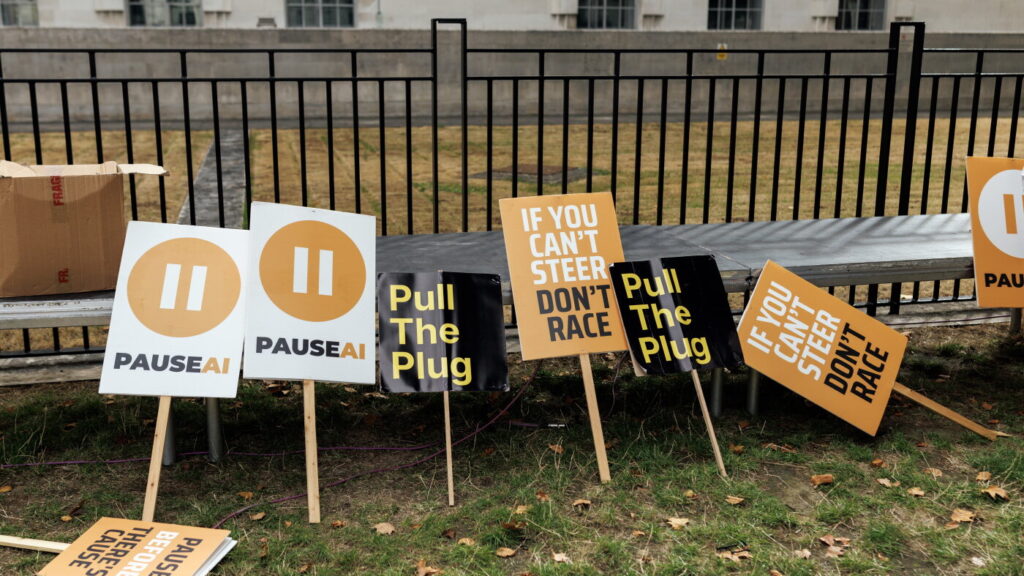
As Silicon Valley executives call for a slowdown in the development of artificial intelligence, a growing chorus of critics has coalesced around a counterargument: Halting the advance of AI will consolidate the power of major tech companies and subdue their upstart rivals.
The debate comes as concerns grow in Washington about autonomous AI agents escaping human control and hacking into private companies, just as current and former employees of AI labs issue dire warnings about the dangers of unfettered AI.
Slowing the rapid progress of AI is now something Anthropic CEO Dario Amodei, OpenAI executive Sam Altman, SpaceXAI owner Elon Musk, Google DeepMind’s Demis Hassabis and Microsoft’s Satya Nadella all say they support, although not all share a common vision for achieving it.
But smaller AI companies say a slowdown in AI will only cement the advantages of companies at the forefront of the industry, often called frontier labs. And other skeptics say stopping AI development would only work with China’s cooperation, which is far from guaranteed.
“If the entire industry freezes, then essentially what would happen is whoever has the strongest model today will dominate the market share,” said David Bellamy, a research scientist at the UAE-backed Foundation Models Institute, which develops open-source artificial intelligence tools.
Bellamy estimates that the institute’s AI model is about six months behind the most advanced models from OpenAI and Anthropic. He maintains that maintaining that gap will make it difficult to compete at a time when both OpenAI and Anthropic are considering blockbuster initial public offerings.
Alvaro Bedoya, a former Federal Trade Commission commissioner under Biden, said a freeze could make the playing field more uneven by putting pressure on smaller companies in ways that could prove ruinous.
“When the powerful incumbents block the market, the rivals, the upstarts, the tough players in that market, can no longer compete on product or quality and service,” Bedoya said. “They are simply excluded. And the options available to them are to be bought out by the incumbent or to go out of business.”
Speaking to NPR, some mid-tier AI companies said they fear a freeze would hurt their businesses at a time when competition is fiercer than ever.
Perplexity, a San Francisco-based artificial intelligence company, said skepticism is justified “when a company asks to be regulated in a way that protects its market position.”
Nick Frosst, co-founder of Toronto-based AI startup Cohere, said that “a privately coordinated blanket slowdown is not a neutral security policy, as it would ensure the advantage of the small number of labs that already have the most computing, capital and distribution, while making it difficult for researchers, startups and other labs to compete.”
Other critics are fighting back in court.
Four consumers of AI products filed a federal lawsuit last week accusing Anthropic, OpenAI, Google and SpaceXAI of making an illegal deal to slow the pace of AI development. “They allege that the deal violates antitrust law and will slow improvements in paid AI subscriptions.”
Then there is the looming China issue.
Some opponents of a slowdown in American AI argue that it would allow Chinese companies to quickly overtake American AI companies.
President Trump is the loudest voice against the AI slowdown in Silicon Valley, writing in Truth Social that fears that AI will go rogue and endanger humanity are overblown and that “the only one happy about this is China.”
Susan Rice, who served as national security adviser in the Obama administration, has pushed for a negotiated freeze with China to halt the training and launch of new models until both Washington and Beijing can ensure that leading AI cannot surpass human control.
“The United States should aim to win the AI race, as long as the race can be won safely. Ultimately, we have more in common with our fellow human beings in China than with the AI agents who could control us all,” Rice recently wrote in The New York Times.
Chinese President Xi Jinping will meet Trump in Washington this week and artificial intelligence will be one of many agenda items.
A lingering question has been how the United States would ensure that China would comply with a slowdown, even if the two nations agreed. Some observers have compared a US-China pact to a nuclear nonproliferation agreement.
In Anthropic CEO Dario Amodei’s recent essay calling for the industry to “cross the border,” he acknowledged that Chinese cooperation was a potential hurdle in any global deal to slow down.
“The global pace will require cooperation with China, the autocratic country with by far the most advanced AI capabilities,” Amodei wrote. “Therefore, any agreement must have ironclad verifiability or must be limited enough that defection is not militarily existential.”
Anthropic financially supports NPR.