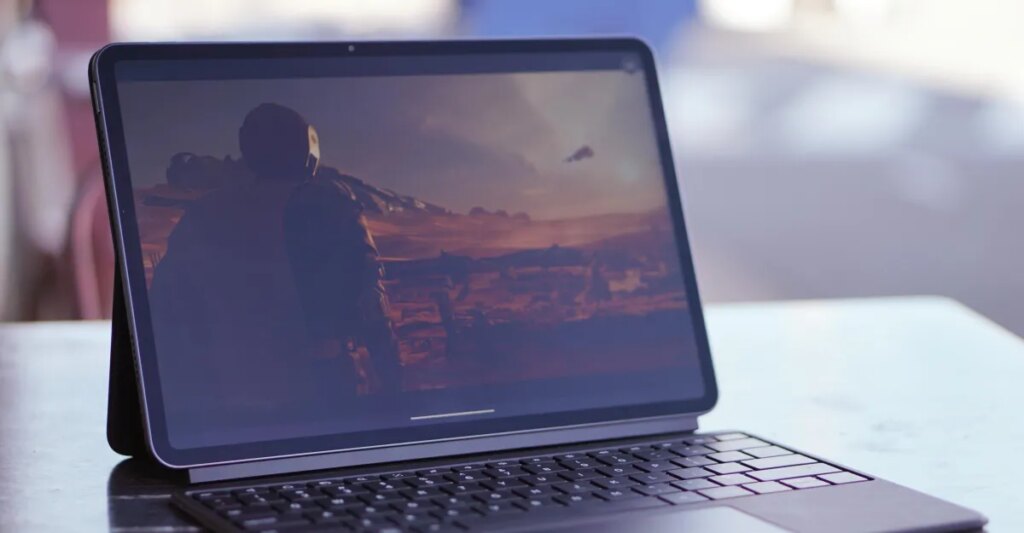
We need to talk about this screen. It’s the first thing you notice, and perhaps the only thing that matters, about the Alexa Tablet 12 Pro. It’s a 12-inch, 2800 x 1840 panel with a new technology that Amazon calls “Nanomatte” that is meant to decrease glare and increase the feeling that you can reach out and touch the things you see on the screen. When Amazon set out to build the best tablet the company has ever released, it started with this screen.
The $549.99 device I’ve been testing is one of four new models in the Alexa tablet line, ranging from a $229.99 8-inch model to a $679.99 12 Pro with this Nanomatte coating and some extra RAM that you don’t really need. The argument for all of those devices is the same: They’re well-made mid-range tablets that can access the full universe of Android apps through the Play Store and come with a lot of Amazon bloatware, whether you want it or not. I haven’t tried those other devices, but I’m glad they exist – it’s very hard to get good, cheap Android tablets.
$550
the good
- The screen is beautiful
- Android Apps!
- Good design and build quality.
bad
- Amazon Bloatware Everywhere
- Alexa Plus is not great
- Some medium specifications
But the Nanomate. The Nanomata! The screen etching, which Amazon says it partnered with Corning to do at a sub-pixel level to reduce glare without causing the slight rainbow glow effect you can get on other matte displays, absolutely does its job. When I use my iPad outdoors, I can often see what’s behind me as if I were looking in a mirror; The 12 Pro reflects only a small shimmer of light and does so without losing sharpness. The viewing angles are also incredible. I wish the screen was a little brighter, but since the main reason for increasing the brightness is to combat glare, it hasn’t really been an issue.
The screen is not perfect. The anti-glare texture gives the Alexa tablet a bit of shine, especially when you’re looking at light text on a black background. And the blacks on the iPad are even blacker; When watching a movie, the top and bottom letterboxes are still slightly illuminated on the Alexa tablet’s LCD screen, and are completely off on the iPad’s OLED panel. You can fix some of this: the 12 Pro has specific modes that automatically adjust tone and color to make reading more enjoyable, and you can even control the overall picture through some presets like the ones you’ll find on your TV. My review unit came with “Boosted” mode activated, which made each color a little too colorful. I set it to “Natural” and immediately liked the image better.
I’m not sure this screen counts as a revolution in display technology, but then again, I reflexively said “whoa” the first second I turned it on, and all that showed up was the Amazon logo. I like this screen for everything. 120Hz refresh rate looks great when running Star Wars: Galactic Corridorand the 3:2 aspect ratio is suitable for web browsing and parallel work. The quieter display modes even make reading more enjoyable than the average big screen, although it’s unfortunate that they only work in the Kindle app. After a few days of using the tablet indoors and outdoors, I prefer the 12 Pro’s screen to any iPad I’ve tested. (Unfortunately, I don’t have an iPad Pro with nano-texture glass to compare it to, but it’s a $2,200 tablet. I doubt anyone is debating between the two.)
All that display technology in a $549.99 device requires tradeoffs basically everywhere else, and Amazon makes a lot of them. The MediaTek Dimensity 8400 processor stacks up against a high-end flagship Android phone from last year and a flagship phone from two years ago, and is completely outperformed by virtually every current iPad. In a graphics-heavy test, the current 13-inch iPad Pro scored about nine times higher.
I would like more horsepower here, but in my daily use there is a lot of power in this tablet. In several days of playing, working, and watching a lot of NFL RedZone, the only slowness I’ve detected has been annoying little things in the Android experience. The app switcher sometimes crashes when loading. I guess I’m a little worried about how this tablet will age, given that it doesn’t share the iPad’s absurd excess of processing power, but for now it’s fine.
Come to think of it, “okay” explains most of the 12 Pro’s hardware. The four speakers are a little thin and muddy, but loud and clear enough. The cameras wash out some colors, but they work for video calls. The $149.99 keyboard case is nice to type on, but a little awkward to take off and manipulate. The $89.99 stylus is smooth and responsive, but not many Android apps support a stylus. The battery lasts about eight hours of screen time, which is a little less than I would like and less than what Amazon advertises. Nothing here is a deal breaker, it’s just a bunch of good.
Software, on the other hand, is all extremes. The good news: Alexa tablets run full Android, not the weird off-brand OS that Amazon’s Fire tablets have used for the past 15 years. That means you get all the apps in the Play Store, a much improved interface, and access to things like Google’s Gemini assistant. That change alone makes these the most functional Amazon tablets ever.
Unfortunately, Amazon did with Android exactly what you fear and perhaps hope for. Amazon took the shit out of things. I’m fine with the slide-out panel on the left of the home screen filled with content recommendations; the overlap of Alexa tablet owners and Prime subscribers/Kindle readers is probably pretty high, and at least that screen isn’t staring you in the face every time you unlock your tablet. I can even live with Amazon preloading its own browser, photos, and music apps, none of which are better than the competition. But it’s downright outrageous that Amazon thinks it can get away with adding two separate, non-removable home screen widgets that serve no purpose other than to advertise Amazon products.
If you’re going to say you “obsess over customers,” you can’t borrow the top left corner of my home screen and then use that space to show me an ad vaguely offering “Cook with premium ingredients” that opens an Alexa chat window that also can’t be hidden in the bottom right corner of my home screen.
Fortunately, this is Android and installing a new launcher takes 30 seconds. If you buy an Alexa Tablet, I recommend doing so immediately.
I’d be less bothered by Alexa’s dominant presence on this tablet if Alexa Plus were actually useful, which it generally isn’t. If you’re looking to buy whatever’s on your screen, Alexa is your robot: You can invoke the assistant in any app, and it’ll almost always assume that your goal is to buy whatever you’re currently looking at. If you want, well, anything else, you’re probably out of luck. Almost a year after its launch, Alexa Plus is not a very good assistant. It’s slow, gets lost in back-and-forth conversations, and still doesn’t have enough access to my apps and data to be useful. You can switch to Gemini in the device settings, and you should.
Once you un-Amazon the tablet, you’ll be left with a pretty useful Android device. And this is where the Alexa tablet becomes difficult to evaluate. I wouldn’t recommend using it as a primary computer, given the sorry state of big-screen Android apps. (Between this and the current Googlebook fiasco, I really hope Google is learning a lesson about incentivizing developers to care about large screens and keyboards.) But between the Kindle-specific display mode, all the reading and streaming apps in the Play Store, and this fantastic screen, this is immediately one of the best tablets for tablets you can buy.
Realistically, you’re probably debating whether to buy the Alexa tablet or an iPad. (Apologies to Samsung Galaxy Tab buyers, but this is a much better buy for almost everyone.) For the same $550 you’ll spend on the 12 Pro, you can get a base model iPad with 256GB of storage. I’d probably tell you to buy the iPad; has much better tablet software and much better big screen apps, and Apple has a much better track record on tablets.
And yet, for the past few days, I’ve had an iPad and an Alexa tablet on my desk, and every time I want to watch or read something, I find myself gravitating toward the Amazon device. It’s really nice to look at in.