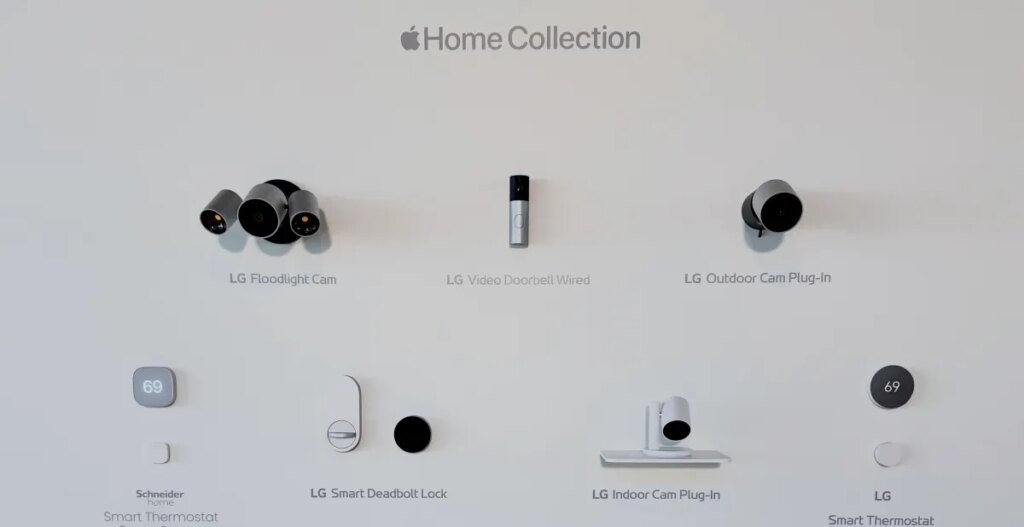
For more than a decade, Apple has asked other companies to create smart home devices for its platform. This week, Apple released theirs. Apple Home Collection is a line of cameras, thermostats, sensors, a smart door lock, and a video doorbell, all co-developed with LG Electronics and Schneider Electric. They arrive together with HomeView, Apple’s first smart screen.
Even after 12 years of HomeKit, Apple’s smart home ecosystem still seemed underdeveloped, especially compared to the competition. The Amazon and Google ecosystems support more products and both have popular in-house brands: Ring and Nest. Apple didn’t have anything of its own that marked customers as an Apple experience, and now it does.
But why now? And is Apple really adding anything new here, or is it mostly packaging? At Apple’s “Welcome Home” event in New York this week, I spoke with Kaiann Drance, Apple’s vice president of home product marketing, about the company’s new approach to the smart home and what this means for Apple’s commitment to Matter, the open, interoperable smart home standard she helped found.
Drance says the big reason for this focus on new smart home hardware was developing the right technologies. The first was Matter, which provided the ecosystem. The second was AI, which brought a more conversational Siri voice assistant. Both were required to create a dedicated home device in HomeView. “With the magic of Siri AI, everything comes together in a way we haven’t been able to offer before,” says Drance. “That’s been a really critical piece in bringing this all together.”
The most important bet is HomeView as a gateway to the smart home.
The biggest bet here is HomeView as a gateway to the smart home for Apple users. Buy one to play music, guided cooking recipes, and check your calendar, and you might soon want a camera or smart lock to go with it. Drance says they’ve seen that once people try a single smart device and find it easier than they expected, “it unlocks this delightful understanding of what’s possible once you bring these products into the home.” She maintains that most people simply don’t know what a smart home can do.
She’s not wrong. The biggest barrier to purchasing smart devices is that people don’t see value in the products, according to research from Parks Associates. Privacy and security concerns and complexity also feature prominently, along with cost. While Apple doesn’t address the cost concern here: the products begin At $200, the other elements are part of its proposition: one-touch setup, your data remains yours, one app to run it all. Apple’s seal of approval also carries a lot of weight. “People who own Apple products are very, very loyal and there is a large user base,” says Elizabeth Parks, president and CMO of Parks Associates.
From a choose-your-own adventure to a customized solution
Until now, Apple Home has been a bit of a buffet: you can choose from any brand that supports HomeKit or Matter and hope for the best. The Home Collection is more like a chef’s choice, a short list of dishes that Apple promises to pair well. Drance says that’s what some customers were asking for. “There are a lot of options with Matter and there are a lot of great products on the market,” he says. “But sometimes we get asked, ‘Hey, what product should I put in the house?’”
Instead of making devices itself, Apple opted to co-develop the line with partners who “have their own in-home experience.” Both have a global presence and expertise in the home, he says, “LG more so in consumer products, Schneider through construction and home installations.” Drance says it was a ground-up collaboration with Apple that brings “the design aesthetic that would be appropriate for the home and appropriate to match our family of products.” The company is also partnering with ADT through Apple retail stores to help people install the devices.
Drance says setup and ease of use were also a big focus in developing the products. “One-touch setup was really important to make it so easy, without needing a separate account or a separate app,” he says. “We just wanted that simplicity to be at the core and of course the privacy that we have developed together with our partners.” She says everything is integrated through Apple Home; You don’t need to create an LG or Schneider account, and all data is end-to-end encrypted, so only you can access it.
Drance made it clear that the Apple Home Collection does not replace the buffet, the hardware ecosystem that has grown around Apple Home. “We still have this incredible ecosystem with Matter and with Works with Apple Home, which is going to remain,” he says. “We know that homes are not a one-size-fits-all solution, so our customers will continue to have that option and we remain committed to building that ecosystem as well.”
The hardware for the most part supports that. The lock, thermostats and sensors are Matter compatible; The lock is Aliro compatible and works completely locally, and all devices are Thread compatible. The exception is cameras, which use Apple’s HomeKit Secure Video, not Matter. That is the biggest blockage. I was surprised that Apple didn’t announce support for the Matter camera. But Thread radios suggest the hardware could be Matter-ready, and Apple could be waiting for the Matter camera standard to support encrypted uploads, something HKSV already does.
So what’s the benefit?
Does the Home Collection do anything other Apple Home devices can’t do? In theory, no; In practice, yes. “What we’ve done with the Apple Home Collection is added another layer on top of that, deeper integration,” says Drance. There are no Home Collection-exclusive features; It’s more what Apple says all the features will be here. It’s a bit like Google making a Pixel phone to show Android developers what Android can do: Apple products come with the full set of capabilities the platform offers.
“One-touch setup was really important to make it so easy, without needing a separate account or a separate app.”
– Kaiann Drance, Apple
According to Apple, setup is as simple as holding your iPhone close to the device, like pairing AirPods, with no additional account or app required and no scanning required. Each device uses Thread to stay connected if Wi-Fi goes down, and Apple says each can update its own network credentials when your Wi-Fi changes. This could fix offline device issues plaguing Apple Home. Everything is end-to-end encrypted and the cameras continue recording to the built-in storage if the Wi-Fi connection goes down.
The devices also support Apple Home features that other manufacturers have been slow to adopt. The LG lock is only the third to offer hands-free home key unlocking via UWB, and both thermostats work with Apple’s Clean Energy Guide and Adaptive Temperature, which adjust based on your location and sleep schedule.
At least that’s the promise. We’ll have to test these devices to see how well they work.
Together, Apple’s new devices form a polished and cohesive smart home starter kit, albeit an expensive one. The cameras, lock, and thermostats cost between $200 and $400, and camera history requires an iCloud Plus plan. As Drance said, the smart home is not a one-size-fits-all solution, so it won’t work for everyone. If you already have a Ring doorbell or a Google Nest Hub, this one probably isn’t for you. Instead, Apple is trying to guide its existing customers who haven’t yet purchased a video doorbell or smart lock down a curated path to the smart home.
However, Apple faces a tougher challenge in the broader market: It’s arriving late. The smart display category is already mature; Millions of homes have smart displays from Echo and Google. Millions more have Ring or Nest doorbells, neither of which will work with HomeView at launch.
As a smart home platform, Apple Home ranks third in adoption, behind Google, with Amazon leading the way, according to research from Parks Associates. But customer loyalty to those platforms is not guaranteed. Four in five smart home households would consider switching, Parks says, especially if another platform lets them control everything from one place. “Interoperability will be critical, but the biggest prize is taking ownership of the relationship with the consumer,” he says.
With its Home Collection, Apple is not reinventing the smart home; is trying to make it easier to get in one.