There’s a fast-growing category of electric two-wheelers that splits the difference between high-end scooters and entry-level motorcycles, new bikes with cutting-edge styling but affordable performance.
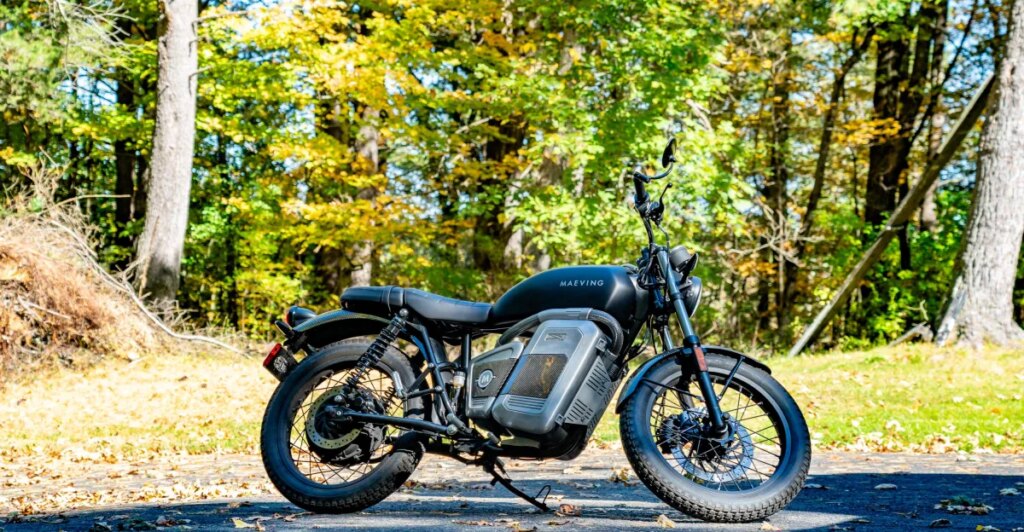
I’m referring to offerings like the Infinite Machine P1 and BMW CE 02, similar concepts but with wildly different attitudes. Among this class, the Maeving RM2 stands out. It has a distinctly retro-futuristic style, bringing together the vibe of classic British motorcycles like the Triumph Bonneville or the Royal Enfield Continental GT, but without the literal vibrations caused by internal combustion.
In fact, quite the opposite. The RM2 is one of the quietest and smoothest motorcycles I have ever ridden. It also has an innovative solution to a common problem with electric motors. Unfortunately, its rough edges make the $10,995 starting price seem a little extravagant.
UK-based Maeving was founded in 2018 and currently has three motorcycles in its stable: the RM1S, the moody Blackout edition, and the RM2. They are all based on the same basic drivetrain and battery technology, with similar power and range.
The difference is the design. The RM1S and Blackout offer a single seat, while the RM2 has a longer saddle and beefier frame that lets you invite a friend along for a ride.
A light friend, anyway. The RM2 features a 15-horsepower, 193 pound-feet electric hub motor integrated into the rear wheel. That’s more torque than beefier motorcycles, so it comes out reasonably well. However, that anemic power figure means it struggles to gain speed.
It’s officially rated for up to 70 mph, but in its most powerful mode it barely topped 63 mph while I kept the throttle wide open for as long as I dared.
If I put my chest on the tank and bent my elbows, I went up a few notches to 67 mph, but to get to 70 I had to wait for the road to descend into a valley. On the return climb I struggled to maintain 60 (for reference, I weigh 172 pounds).
That’s not the kind of performance that would make me comfortable riding with a passenger in the back. Power, then, is not the RM2’s strong suit, but that doesn’t mean it lacks charm.
While I love the sound of many motorcycles, lately I’ve been loving the serenity of riding an electric motorcycle. I’ve tried many e-bikes over the years, but none offered the peace and quiet of the RM2.
The hub motor design means there is absolutely no noise in the transmission. Most electric motorcycles rely on chains or belts to send power to the rear wheel, and even the quietest ones add some sort of shock to your ride. On the RM2 the only thing I hear is the wind.
Well, the wind and a persistent buzzing sound from the front fender every time I hit a pothole. As many vehicle manufacturers have learned, the absolute silence of an electric vehicle means that noises that were previously drowned out by the white noise of internal combustion can suddenly become quite annoying.
Unfortunately, that wasn’t the only thing that made noise on the RM2 I tested. The left bar end mirror was so loose I feared it might fall off, and the front wheel seemed to chatter over every imperfection in the asphalt, creating an unstable feeling due to the non-adjustable front fork.
Overall, the bike’s suspension just didn’t seem up to the task. The biggest hits threw me out of the saddle with such force that I got into the habit of getting up as I approached obstacles. And that’s even though my test machine had $995 upgraded shocks in the rear.
That rear suspension has more to do with the weight of the hub motor. But mounting it there frees up space inside the RM2’s frame, creating a delightfully simple look and keeping the weight down: just 320 pounds. Combine that with a 30.5-inch seat height and you have a wonderfully easy-to-handle machine.
The engine’s traditional place in the frame is taken by a forward-angled battery unit. Press a button on the left grip and the battery door opens, revealing a pair of removable packs. Each has its own button to release it from the bike, then simply twist the integrated handle and carry it inside to carry under your desk.
That’s the theory, anyway. In practice, you will have to press that button several times, as it never worked for me on the first try. Likewise, the bike often didn’t recognize when I closed the door again, displaying an error code on the digital dash until I opened it and hit the door several times.
Each of the 2.73 kilowatt-hour packs weighs 36 pounds and features an uncomfortably thin plastic handle. Do you want to feel what it’s like to wear one? Fill a 5-gallon bucket with water three-quarters full and then take it to your office or apartment. While it’s great in concept, it’s not something I would like to do on a regular basis.
Unfortunately, you may have to do this if you don’t have access to external charging. The RM2 is officially rated for 80 miles on a charge, but I think the only way to achieve this is to keep the bike’s default riding mode, limited to 45 mph. In Sport mode, I averaged about 50 miles per charge.
If you don’t want to carry those backpacks with you, you can charge the bike directly through a connector on the side. Unfortunately, it is proprietary and only works with the included charger. Maeving offers an adapter to charge on a standard SAE J1772 connector, but it costs a whopping $440 and doesn’t increase charging speeds.
The good news is that there is room to store that charger directly on the bike. What looks like a fuel tank is actually a lockable storage compartment. It’s the perfect size for a quick run to pick up milk or takeout from your local Thai restaurant.
The RM2 certainly has a lot of room for improvement, but at the end of my time with it, I was still quite delighted. It’s such an attractive and easy-to-use machine that I wanted to hop on it for every errand I had to run.
Well, all the errands that didn’t take me on the road or more than 40 kilometers from home, at least. I wouldn’t trust the RM2 to go any further, and with an 80 percent charge requiring four hours on the standard charger, road travel is out of the question.
And then there’s the cost. The Maeving RM2 starts at $10,995, but when you add the matte paint, upgraded suspension, and carbon fiber fenders from my test bike, you get a price of $13,275. For that money, you could buy two Royal Enfield Continental GT motorcycles, and as much as I like the electric motor, it’s a tough financial pill to swallow.
Photography by Tim Stevens/The Verge