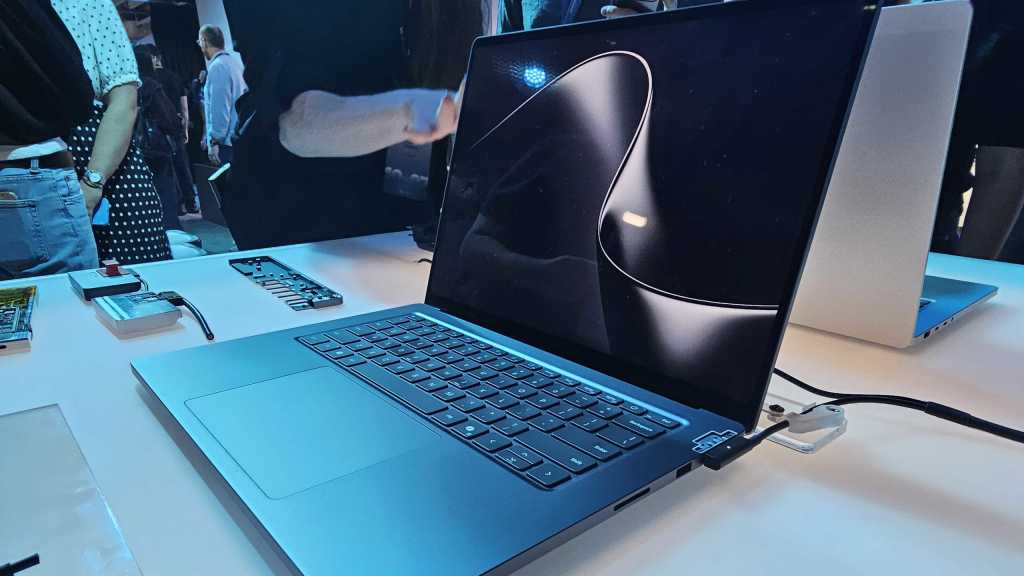
There are more compensations. Users will be able to run models locally, but the Surface Laptop Ultra ships with a 140W power adapter. That’s a sign that it will consume a lot more power than typical laptops, although not gaming laptops. (That’s another question: is this a gaming laptop? Microsoft showed off just one gears of war game running at Ultra, no frame rate indication).
However, I left the Windows and Surface event with a question that no one at Microsoft could answer: What will the battery life of these laptops be? In a demonstration, Microsoft employee Kayla Cinnamon proudly put the Surface Laptop Ultra into “airplane mode,” showing how the laptop could operate completely disconnected from a network.
(Microsoft’s official stance: “Surface Laptop Ultra battery life details will be shared when available,” reads the Ultra specs page. “Varies based on usage, settings, configuration, and other factors.”)
But These Laptops May Not Even Work in airplanes. For one thing, 140W is more than some airplane power outlets can supply; 110W to 150W is apparently typical. (Edit: Jason Rabinowitz, co-host of the AVTalk podcast and avid airline enthusiast, says 60 to 100 watts is actually more common.) Can you run AI agents continuously during a 13-hour flight from San Francisco to Taiwan? I highly doubt it. We don’t even have a reliable way to test battery life while churning tokens.
All of these unknowns made the analysts I spoke to shake their heads. Who is going to buy these devices? The $2,599 price is the base price, meaning that as users increase their memory capacity (to run larger, more powerful AI models), the price will increase with it. We’re still in 2026, a time when the $699 Apple MacBook Neo made headlines.
“I think it’s very obvious that no one wants to spend all this crazy money [on cloud AI]”said analyst Bob O’Donnell, director of Technalysis. But it remains to be seen how users want to divide their work between slower on-premises AI and faster, more expensive cloud models.