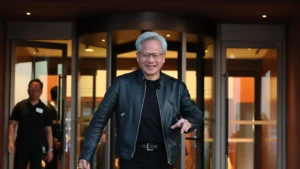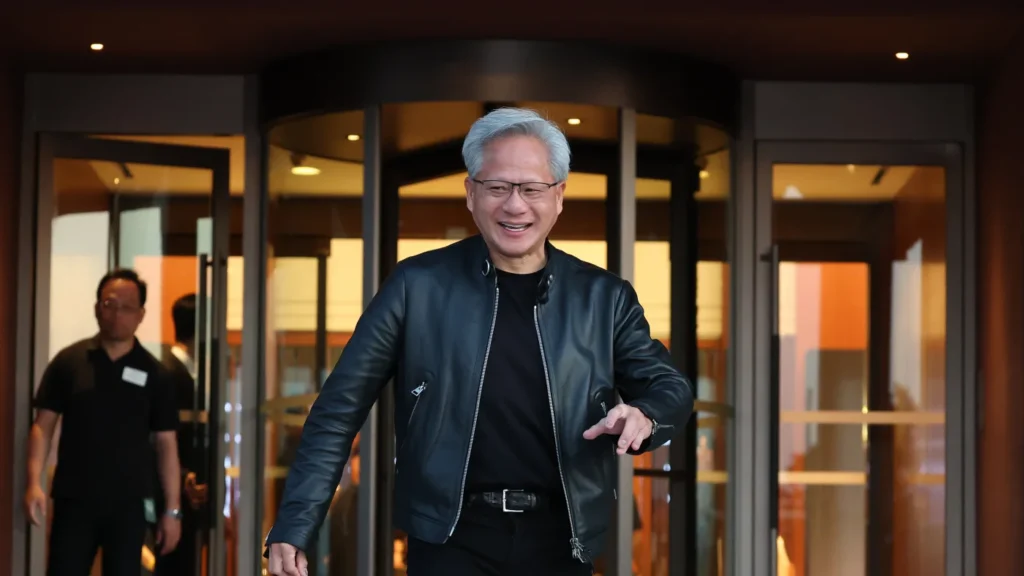
Nvidia CEO Jensen Huang speaks to the media after a roundtable with South Korean robotics and artificial intelligence startups on June 8, 2026, in Seoul, South Korea.
Chung Sung-Jun/Getty Images Asia Pacific
hide title
Chung Sung-Jun/Getty Images Asia Pacific
Sign up for NPR’s Up First morning newsletter to get the stories you need to start your day.
On Monday morning, a couple of hours after Nvidia’s board of directors announced that it had reinstated co-founder Jensen Huang as CEO, President Trump shared an AI-generated image on social media.
It’s based on that shocking photo of the president from 2024, just after he survived an assassination attempt. Surrounded by Secret Service agents, his face bloodied, Trump raises a defiant fist in the air.
In the manipulated photo, instead of Trump, it is Huang. An Nvidia flag flies behind him. And in her raised fist, she holds a red bra.
“I was absolutely flabbergasted,” says Bo Young Lee, who worked as chief diversity officer at Uber for five years starting in 2018.
To Lee, it seems like Trump is suggesting that Nvidia’s CEO is as important to the country as he is.
“But also the red bra is an indication that it’s open hunting season for women,” he says. “This raises all kinds of stereotypes and misogynistic perspectives about women.”
For others, the image leads to the idea that in Silicon Valley, as long as you are successful, anything goes.
The White House has not responded to NPR’s questions about what Trump was trying to say with the image.
Spy intrigue overshadows workplace transgressions
Although Huang’s return to Nvidia has been applauded by investors, some employees and Trump, it has provoked shock and disbelief among others, including those who have long worked to improve workplace culture in Silicon Valley.
“It’s actually unfathomable to me,” says Lee, who now serves as an advisor to AI4ALL, a nonprofit dedicated to increasing diversity, inclusion, and responsible practices in artificial intelligence.
After The New York Times revealed that Huang had had an extramarital affair with a woman the U.S. government believes is a Chinese intelligence asset, Lee noted how the broader conversation was dominated by concerns about national security, corporate governance and Nvidia’s stock price.
That scandal overshadowed allegations of other problematic workplace behavior, specifically Huang’s alleged affair with Kimberly Powell, Nvidia’s vice president of healthcare, one of Huang’s many direct reports.
“Everyone downplays that supposed relationship because of who she is,” Lee says.
The fact that Powell is a high-level leader who makes a lot of money shouldn’t matter, Lee says. He argues that people in subordinate roles, even powerful ones, cannot give proper consent, “simply because there is this power difference.”
Nvidia’s board of directors found Huang’s behavior to be “inconsistent” with the company’s code of conduct. On Monday morning that didn’t seem to matter.
“The board of directors voted unanimously to reinstate Mr. Huang after a series of discussions and meetings with Mr. Huang, after which the board was satisfied with Mr. Huang’s candor and his ability to lead Nvidia,” the board said in a statement.
Lee says that response sends a message to Nvidia employees and all of Silicon Valley that it’s okay to break the rules as long as you’re sincere.
“‘Just be transparent with us,'” he imagines the board saying.
Nvidia did not respond to NPR’s questions about Lee’s concerns.
A deepening of the “tech bro” culture in Trump’s second term
In Silicon Valley there have been private conversations about Huang’s alleged transgressions in the workplace and the power dynamics at play, but the women do not seem willing to speak publicly.
NPR reached out to two dozen women working in the tech space. Freada Kapor Klein was one of the few willing to speak. The social impact investor says conversations about workplace behavior are much quieter than in other times, such as in 2017 and 2018, when several venture capitalists resigned amid accusations that they were sexually harassing female entrepreneurs.
In 2017, Kapor Klein and her husband, Mitch Kapor, used their positions as early investors in Uber to publicly call out the company for its toxic culture, which they said tolerated bullying and harassment. Co-founder and CEO Travis Kalanick eventually resigned. Kapor Klein hoped it would be a learning moment.
But now he feels Silicon Valley has gone backwards.
“Tech culture is stronger now than I’ve seen it in decades,” he says, adding that Trump’s attacks on DEI have amplified that culture.
Among women and people of color in Silicon Valley, she says there’s real concern now about anti-DEI sentiment: the elimination of programs, chief diversity officers, and employee resource groups.
“Virtually all supports or mechanisms have been eliminated,” he says.
Screens show the news of Jensen Huang’s reinstatement, seen outside the NASDAQ MarketSite, in New York, on November 23, 2026.
Angela Weiss/AFP via Getty Images
hide title
Angela Weiss/AFP via Getty Images
“The only thing that matters is money”
To be clear, Huang has not been accused of predatory behavior. Still, Kapor Klein says his quick return is concerning.
“It’s a resounding message that the only thing that matters is money,” he says. “If you are considered a singular talent, you can violate corporate policy, you can possibly threaten national security, you can make your own rules on the fly, you can create a toxic work culture, as long as you put money in.”
As of late last week, Nvidia shares had fallen nearly 49% from their peak in October, and about 27% since before Huang’s resignation. On Monday he recovered significantly.
Lee says Silicon Valley has always had an unhealthy relationship with its “genius founders.”
“We elevate these leaders to godlike levels, and that’s been done to Mark Zuckerberg, and that’s being done to Sam Altman, and that’s definitely [been] done to Jensen Huang,” Lee says. “At that point you become untouchable.”
Kapor Klein says what happened at Nvidia has made it abundantly clear that AI companies need guardrails for their CEOs, not just for the tools they are creating.
“We see a board that ignored that,” he says. “There are no guardrails for this CEO’s behavior.”
NPR’s Scott Horsley contributed to this story.