My colleague Ben Patterson covered the evolution from cloud AI to agent AI through his Prompt Mode newsletter, so I felt confident he could back me up if needed. Still, there is no better way than learning by doing.
Welcome to the PCWorld newsletter, Smart Mode! The focus of this newsletter is productivity: from software to hardware to peripherals, all with the idea of accomplishing what you need to do efficiently.
I’m your host, Mark Hachman, covering the productivity tips, tools, and trends you need to know, both inside and outside of PCWorld. If you’d like to receive the latest issue in your inbox every week, simply sign up here.
Frankly, agent AI makes me nervous. Hermes is an OpenClaw AI competitor, which scared even veteran AI users with its ability to break into your PC. On the other hand, its agent nature means that it can autonomously perform tasks that other AIs cannot. Waiting a bit before trying it seemed like a good idea.
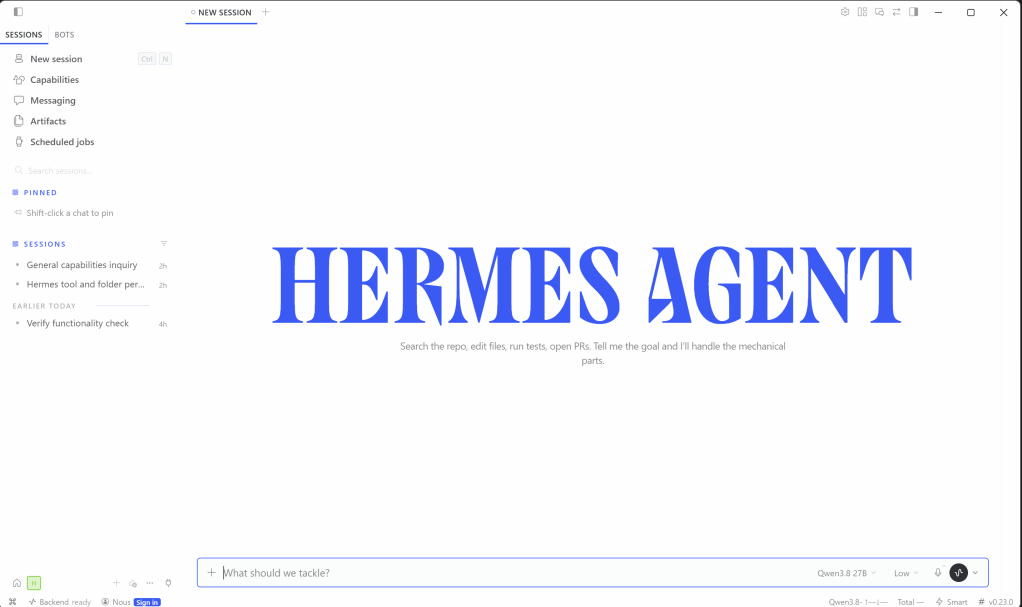
Again, my first experience with Hermes came with the Surface Laptop Ultra, whose (relatively) modest memory load (32GB) meant the memory would be split between system memory and VRAM. Lower VRAM means smaller local models and, in this case, possibly slower performance. Initially, I toyed with Hermes as a test laptop.
Mark Hachman / Foundry
What I noticed right away was that the default settings leaned aggressively on the side of security. One of the first things I did was ask for some performance metric, as a way to track the number of tokens the laptop was producing. Hermes has the ability to go out, search the web, click and install software on your PC. Here, Hermes was almost a textbook case of passive aggressiveness, asking me to approve every mouse move and click manually. That was a clear waste of time. You’ve heard of humans training AI. I felt like I was being trained to give Hermes complete control!
In fact, I didn’t get very far with Hermes on the Surface before a colleague asked if I could borrow it. I cleaned the contents of the laptop and handed it to him. However, I was interested to see what Hermes would do on a successive run, so I opened up another RTX Spark machine to dig a little deeper.
Local AI can fail… and failure can take forever
As with the first laptop, I downloaded the Hermes app from the Microsoft Store. This second laptop had 64GB of RAM, so a bit more memory was allocated to the GPU and its AI capabilities. What I didn’t expect is that Hermes immediately decided that it would behave autonomously, without my intervention in each and every click. As far as I can remember, I never allowed the original Hermes implementation to respond that way. In any case, I’m not sure my preferences would have been saved to the cloud..