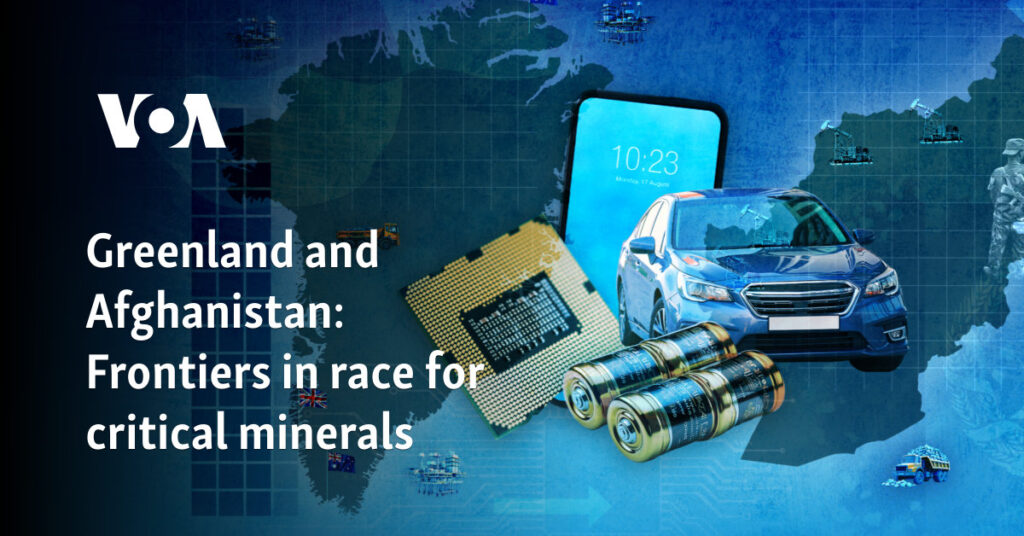
Just as discoveries of fossil fuel reserves helped shape the 20th century, the race for critical minerals is shaping the 21st century. These minerals are considered strategically crucial to modern economies, including those used in construction, energy and manufacturing, particularly for semiconductors and other technological applications.
Where mineral resources are located and extracted has often played an important role in geopolitical and economic relations. Today, the world’s attention is focused on two locations believed to be rich in untapped reserves, but accessing each comes with unique challenges.
Afghanistan
Located at the intersection of multiple tectonic plates, Afghanistan’s geology has given rise to extensive and diverse mineral deposits. Historically, its territory was a primary source of copper and gold, as well as gems and semiprecious stones, particularly lapis lazuli, a stone prized for its intense blue color.
Today, Afghanistan is estimated to have mineral reserves worth almost $1 trillion. This includes 60 million tonnes of copper, 183 million tonnes of aluminum and 2.2 billion tonnes of iron ore. Gold is mined on an artisanal scale in the northern and eastern provinces, while the mountainous north contains valuable deposits of marble and limestone used in construction.
The China National Petroleum Corporation also pumps oil in the north, although Afghanistan has no domestic refining capacity and relies on fuel from neighbors such as Turkmenistan, Iran and Kyrgyzstan.
However, most international attention is focused on Afghanistan’s other metal deposits, many of which are crucial to emerging technologies. These include cobalt, lithium and niobium, used in batteries and other electronic products. The country’s unexplored lithium reserves may even exceed those of Bolivia, currently the largest in the world.
Afghanistan also has significant deposits of rare earth metals such as lanthanum, cerium and neodymium, which are used for magnets and semiconductors, as well as other specialized manufacturing applications.
One obstacle to Afghanistan’s mineral extraction is its terrain, considered the eighth most mountainous in the world. But security has been a much bigger impediment. Amid the political instability that followed the first fall of the Taliban in 2001, many gemstone and copper mines operated illegally under the command of local militants. As workers were paid very little and the product was smuggled out to be sold in neighboring Pakistan, the Afghan people saw little benefit from these extraction operations.
Since regaining power in 2021, the Taliban, who have been eager to tap the country’s mineral wealth and increase exports, have been hampered by a lack of diplomatic recognition and their designation as a terrorist group by multiple nations. However, this is beginning to change, as some countries establish de facto diplomatic relations.
In 2024, the Taliban government’s resources ministry announced that it had secured investments from China, Qatar, Türkiye, Iran and the United Kingdom. China, which was the first nation to accredit a Taliban-appointed ambassador, is expected to be a major player in Afghanistan’s extractive industries as part of its Belt and Road Initiative.
However, as newly discovered deposits require an average of 16 years to become operational mines, harnessing Afghanistan’s mineral potential will require huge investment and time, if political and security issues can somehow be resolved.
Green Earth
For millions of years, Greenland has been largely covered by a sheet of ice, habitable only in coastal areas. Despite some offshore oil and gas exploration, fishing and whaling remain the main non-government industries.
Now, as the ice retreats due to climate change, the big island’s frozen interior offers new opportunities in untapped mineral resources. These include more common metals such as copper and gold, as well as titanium and graphite. But as elsewhere, there is even greater interest in Greenland’s technology-critical mineral deposits.
The Danish autonomous territory is estimated to contain deposits of 43 of the 50 minerals designated by the United States as crucial to national security. These include the coveted rare earth metals, as well as other metals with technological applications such as vanadium and chromium.
Currently, most of the world’s rare earth metals are mined in China, making Greenland’s deposits vital for countries seeking to reduce their dependence on Chinese imports. This strategic importance is one of the factors that led US President Donald Trump to propose buying Greenland from Denmark.
The Greenland government has issued almost 100 mining licenses to companies such as KoBold Metals and Rio Tinto. But these have mainly involved exploration, with only two mines currently operating in the country. Putting a mine into production can take up to a decade, because it involves several unique challenges.
One of those obstacles is Greenland’s strong environmental movement, which has successfully shut down mining projects over safety concerns. Rare earths pose a particular problem because they must be extracted from other minerals, a process that can cause waste and pollution. At the Kvanefjeld plant in the south, metals were extracted from uranium ore until fears of radioactive contamination led to a ban.
Receding ice and a warming climate have made extraction easier not only by revealing more territory but also by extending possible working hours and making ships easier to navigate. However, the environment remains harsh and inhospitable, and the island suffers from a lack of infrastructure, with few roads or energy facilities outside the main settlements. However, the Greenland government views the mining industry as an important means of developing the economy.
Conclusion
Determined by both politics and geography, Greenland and Afghanistan have become two important frontiers in the global fight for critical minerals. Which parties will have the opportunity to benefit from its resources will depend on the interaction of military power, economics and diplomacy.