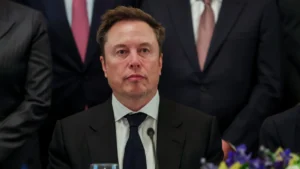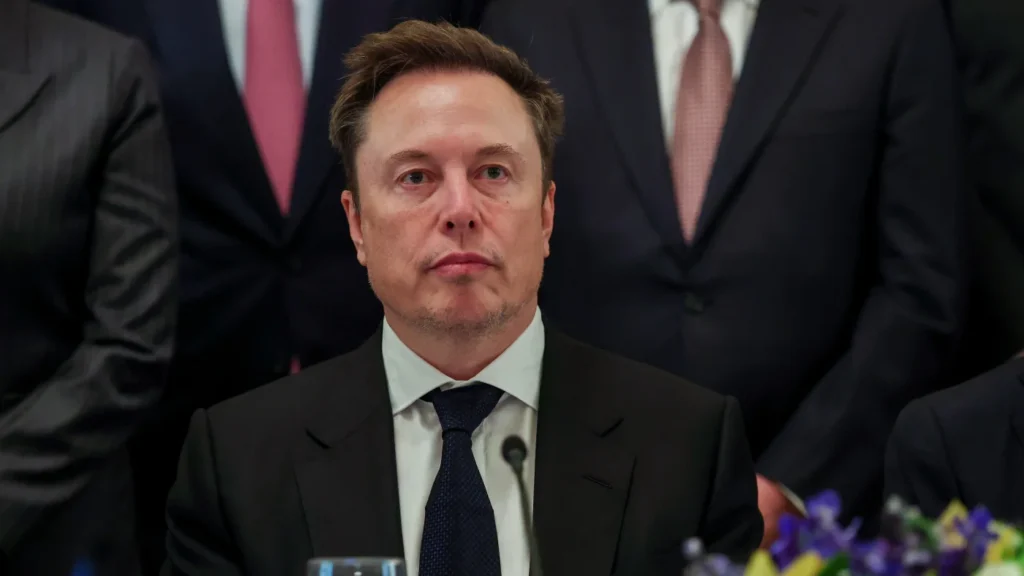
Elon Musk donated more than $445 million to Republican candidates, political action committees and outside groups, according to federal election filings, but most of the candidates he endorsed on Tuesday lost.
Kevin Dietsch/Getty Images
hide title
Kevin Dietsch/Getty Images
Elon Musk was not on Tuesday’s ballot, but he stands to lose big from Democrats’ sweeping midterm victories in the House and Senate. In no state was this felt more acutely than in Texas, home to the headquarters of Musk’s companies and where he spent more than $200 million, according to federal documents, on a mission to tilt the Senate race in favor of the Republican candidate.
With a Democratic majority in Congress, the billionaire, who controls Tesla and SpaceX, will likely face investigations into the billions of dollars in government contracts his companies have received since President Trump returned to power and his role leading the Department of Government Efficiency at the start of Trump’s second term.
Musk donated more than $445 million to Republican candidates, political action committees and outside groups, according to federal election documents analyzed by OpenSecrets, a nonprofit that tracks campaign spending. That makes him the top donor in the midterm elections and among the largest political donors in American history.
The central question Democratic lawmakers say they want answered is whether Musk used his influence within the Trump administration to benefit his own businesses, and whether taxpayer money, government data and public institutions were put at risk in the process.
During the four months that Musk ran DOGE, he received at least $6.3 billion in government contracts. Since then, it has won at least another $10 billion in government contracts, according to the Democracy Defenders Fund, a nonprofit legal advocacy organization.
“DOGE chickens are coming home to roost. Elon Musk waved a chainsaw on stage and laughed as he fired public officials and destroyed the services Americans depend on. Then he lied to the American people about savings. He must answer for it under oath,” Rep. James Walkinshaw (D-Va.) wrote in X.
Musk’s overseas businesses are also under scrutiny. Democratic Sen. Chris Coons of Delaware posted on X that Musk’s ties to Russian President Vladimir Putin are “one more thing to add to the list of questions for Musk when I subpoena him.”
U.S. Rep. Mike Levin of California noted that Musk restricted Ukraine’s use of its Starlink satellite internet service days after Trump eased sanctions on Russia and began buying Russian diesel in October. Starlink and its military-grade counterpart, Starshield, are vital to Ukraine’s civilian infrastructure, frontline communications and drone operations in its war against Russia.
“How the hell did we get to this point? How is it possible that Musk can disrupt the military operations of an American ally whenever he wants, maintain a clear line with the Kremlin, and not be held accountable to the American people or government?” Levin wrote in X.
Musk did not respond to a request for comment from NPR.
While he ran DOGE, Musk was a part-time special government employee and, as such, was subject to a federal law that prohibited the covered executive branch and related staff from participating in official matters that affected his personal financial interests, said Richard Painter, former chief White House ethics lawyer during the George W. Bush administration.
“SpaceX is a big contractor and receives a lot of money from NASA and the Department of Defense. Yes [Musk] touched anything that he knew would have an impact on SpaceX, he would have committed a crime,” Painter said.
Texas has played a growing role in Musk’s business empire
Texas in particular has become a major focus of Musk’s efforts to wield political power, as he has made the state the nerve center of his growing business empire. Tesla’s corporate headquarters and a major vehicle manufacturing facility are located in Austin. X, formerly Twitter, is based outside of Austin. SpaceX, which makes rockets and satellites, is based in south Texas. Musk’s Neuralink and The Boring Company are also based in the state.
Much of Musk’s estimated wealth is tied to his stakes in his companies. Even as markets rose on Wednesday after Democrats’ midterm election victories, shares of SpaceX fell nearly 4% and Tesla fell 3%.
SpaceX is reportedly exploring several potential sites in Texas for large data centers. Tesla owns and operates its massive Giga Texas data center in Austin. In August, plans were announced for a $16.8 billion SpaceXAI semiconductor manufacturing project in Texas.
Musk committed at least $225 million of his midterm spending to Texas, according to OpenSecrets, including supporting Republican Ken Paxton’s bid for the U.S. Senate and Gov. Greg Abbott’s re-election campaign.
But Paxton and Abbott lost, suggesting that Musk’s money was not enough to overcome a wave of enthusiasm that saw Democrats capture every state office in Texas.
“Elon Musk wants our land. He wants our water. He wants our tax money. He wants his own personal United States senator. He’s trying to buy Texas,” James Talarico, who defeated Paxton in the Senate race, said at a campaign rally in Lubbock last month.
Elon Musk’s own X posts about Talarico were often personal and inflammatory. “Talarico will vote for his children to be trans,” he wrote on November 1.
Talarico addressed Musk in his victory speech on Tuesday.
“We just sent a message to every billionaire mega-donor, every billionaire mega-donor, every corrupt defender of this broken political system in this state, in this country. The power belongs to the people,” Talarico said. “The real struggle in this country is not right against left; it is top against bottom.”
When the results came in Tuesday night, Musk wrote on