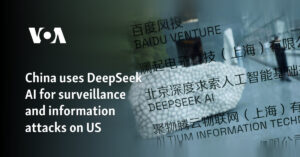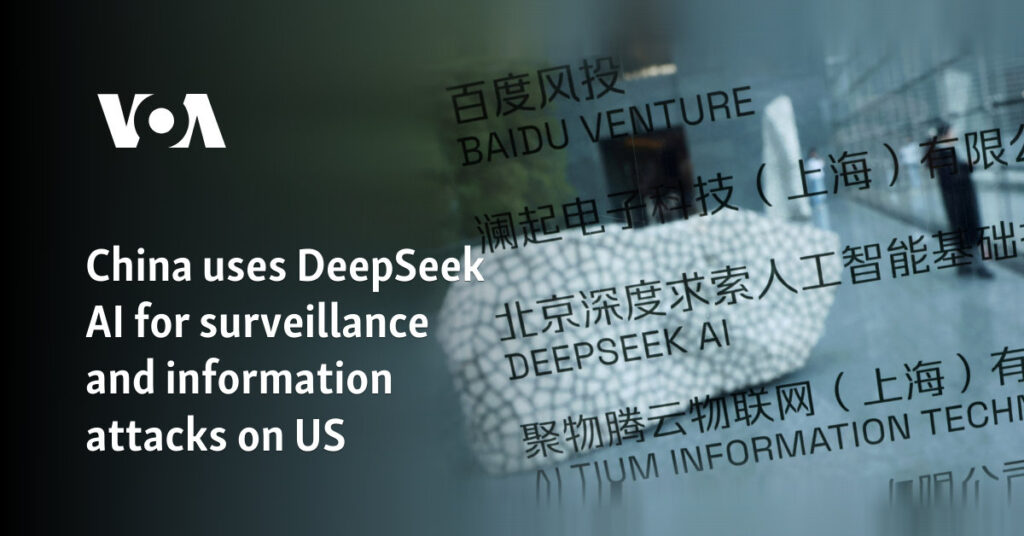
The United States may become the second country after Australia to ban China’s DeepSeek artificial intelligence on government devices.
U.S. Representatives Josh Gottheimer and Darin LaHood introduced a bipartisan bill proposing the ban.
In their letter to 47 US governors and the mayor of Washington, the congressmen warned that DeepSeek could pose security risks to sensitive government data and the cybersecurity and privacy of Americans, NBC News reported on March 3.
China denies the accusations. However, the concerns highlighted by US lawmakers and state officials are not unfounded, experts say.
The Chinese government has also reportedly used artificial intelligence models for mass surveillance, including biometric data collection and social media eavesdropping operations that inform China’s security services and military, as well as for information attacks against American and Chinese dissidents abroad.
At least three leading Chinese surveillance and security companies (TopSec, QAX and NetEase) announced the integration of DeepSeek to improve their services.
TopSec and QAX provide services directly to the Chinese government, and NetEase made it clear that DeepSeek will enhance its cyber surveillance and censorship capabilities.
Over the past decade, the Chinese government has been investing heavily in AI-powered surveillance, facial recognition and biometric data capture technologies, such as “smart cities,” the Skynet project and the Sharpe Eyes program, which can monitor all aspects of an individual’s public life, Wenhao Ma of VOA’s China Division reported.
In January, Canadian cybersecurity firm Feroot Security discovered code embedded in DeepSeek’s login processes that shares user information with Chinese state-owned communications company China Mobile, the AP reported.
The Associated Press described the code as a “very confusing computer script that, when deciphered, shows connections to computer infrastructure owned by China Mobile.”
The United States banned China Mobile in 2019 following intelligence reports that it serves as a spy arm of the Chinese military.
China-based actors have been using ChatGPT along with DeepSeek models to generate phishing emails and disinformation attacks in the US “on behalf of unspecified customers in China,” OpenAI said in its February report.
OpenAI identified and blocked a group of accounts originating from China involved in malicious activities, such as Qianyue Overseas Public Opinion AI Assistant, allegedly designed to ingest and analyze posts and comments related to Chinese politics and human rights from platforms such as X, Facebook, YouTube, Instagram, Telegram, and Reddit.
The purpose of the operation was reportedly to “convey the resulting insights to Chinese authorities” such as “Chinese embassies abroad and intelligence agents monitoring protests in countries such as the United States, Germany and the United Kingdom,” OpenAI said.
A set of ChatGPT accounts that OpenAI banned in February had been involved in Chinese influence operations focused on generating short comments in English and long articles in Spanish critical of the United States published in local and national media outlets in Latin America and Spain.
One of the Chinese companies that placed the articles in Spanish-language media was Jilin Yousen Culture Communication Co., a subsidiary of the government-linked Beijing United Publishing House.
VOA reviewed nine of the AI-generated Chinese articles published in Spanish-language media between October and November 2024, as identified by OpenAI.
Two: in Mexico The Universal and Peru The Popular — criticized the United States’ use of sanctions against foreign governments and individuals.
He The Universal The op-ed described U.S. sanctions on Iran’s oil industry over Tehran’s support for terrorist groups Hamas and Hezbollah as exposing America’s “powerlessness” in addressing global politics and the “rapid decline” of its “moral standing.”
Similarly, The Popular described US sanctions on a Hamas affiliate as “insanity” and an “attack on the rights of the Palestinian people.”
An article in Peru The Republic presented the United States as the biggest beneficiary of the Russian war in Ukraine, replicating the Kremlin’s key narrative. He criticized the United States for providing military aid to kyiv, framing American support as an escalation of the war.
China, however, has been a key supplier of military technologies and weapons to Russia, which Moscow uses in daily attacks against Ukrainian civilians.
Another piece planted by China in The Republic described US President Donald Trump’s tariff policy as “undermining the United States’ global leadership position.”
Three pieces in Peru Here, The Popular and The Plural exploited the problems of homelessness, child nutrition, and crime in the United States, all of which were presented as extremely serious and dangerous.
For example, the article on child nutrition stated that most children in the United States “go hungry on weekends and holidays” due to the government’s neglect of child food security.
While the topics of these articles range from human rights and social issues in the United States to domestic and foreign policy, they all paint a picture of a dysfunctional state with failing moral values and declining international influence, matching the standard Beijing narrative.