After Apple bravely removed the headphone jack from the iPhone in 2016, most people switched to Bluetooth headphones and never looked back. But their wired counterparts have held up, and their sales even increased this year after five years of decline.
Part of the resurgence may be related to the fact that they are now popular with younger generations, following the resurgence of tape recorders and vinyl. Celebrities have been seen wearing them and there is even an Instagram account following the trend. Wired headphones have real benefits. They don’t require a battery, so they’ll last longer than wireless ones that eventually run out, and it’s much harder to lose a pair with a long cord than a single earbud.
Now, after more than a decade, Bose has returned to the wired world, but the Bose Noise Canceling Wired Headphones aren’t a throwback.
$99
the good
- One of the few sets of wired headphones with ANC
- Comfortable and secure fit
- High resolution audio
- Easy to use
bad
- Call quality is not great
- Wind noise is distracting
The $99 noise-canceling wired headphones connect via USB-C, so they don’t need an additional dongle to work with today’s phones. This is also how they can offer ANC. Because the 3.5mm or 4.4mm analog audio jack doesn’t provide enough power for active noise cancellation, most wired headphones, from cheap brands to wildly expensive audiophile in-ear monitors, rely solely on passive isolation. Bose’s last attempt at wired in-ear headphones with ANC, 2013’s QuietComfort 20, had a 3.5mm jack and its ANC relied on a rechargeable battery in the cable. The new Bose headphones do not need a battery; they can get the minimum power they need for ANC from the USB-C port.
There are a few other USB-C wired headphones with active noise cancellation, but not many. There’s also the $30 Belkin SoundForm ANC wired headphones, which reportedly have weak noise cancellation, and Audio-Technica released a pair in Asia earlier this year.
The best part about Bose headphones, or any wired headphones, is that they are simple. There’s no need to worry about pairing them, no need to charge them, and no need to fiddle with an app. Plug them into the USB-C port of a phone or computer and they just work.
While the noise cancellation performance isn’t on par with Bose’s Bluetooth headphones (the wired headphones have two microphones per side, while the QuietComfort headphones have three), it’s still solid for the price. It does a great job of blocking out low-frequency sounds like those from air conditioners and low truck noises, but struggles to mute conversation (with ANC on, I can’t hear our air conditioner at all, but I can make out every word of my wife’s phone conversation as I write this). There is a slight high-end hiss when noise cancellation is active, but it’s only noticeable when no sound is playing.
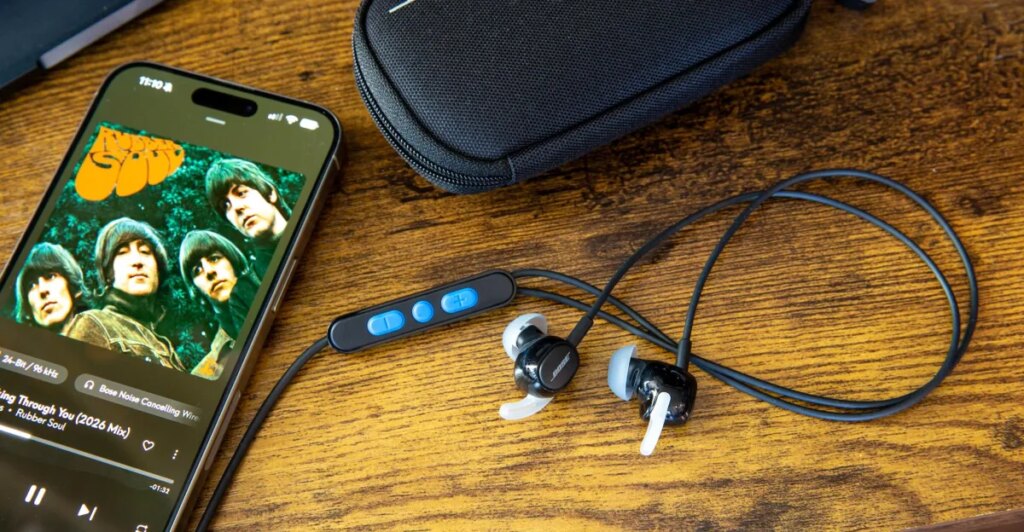
And they sound great. Vocals are clear and bright, and bass is punchy without overwhelming other instruments. I wouldn’t mind being able to reduce the high-end brightness a bit (mainly to control the sound of the cymbals), but since these don’t use an app, there are no EQ options. The wired connection allows for low latency, so you don’t have to worry about sound and video alignment, and they support 24-bit/48kHz high-resolution audio. I went back and forth between CD quality (16-bit/44.1 kHz) and high-resolution streams of The Beatles’ new release. rubber core on Qobuz, and the hi-res versions sounded a bit more open and spacious. It’s not a huge difference, but I’d listen to the hi-res version on the Bose via CD-level streaming any day.
The inline remote has three buttons that control volume, playback, and noise cancellation mode selection. They respond quickly when pressed and have a nice rubbery texture. The earbuds come with three sizes of ear tips and two sets of wings to find a good fit (you don’t even need to use the wings if they’re uncomfortable). I was easily able to find a comfortable match and they stayed secure in my ears for hours. The earbuds are also IPX4 rated if it rains lightly while you’re out or if you want to use them while running.
However, even with the benefits of wired headphones, nostalgia can’t erase the frustrations. If you don’t run the 4.2-foot cord under your shirt or roll the excess into your jacket pocket, it will snag. all. In my short time with the Bose, the cable has gotten caught on the handle of a kitchen drawer, the edge of my keyboard, the zipper of my sweatshirt, the strap of a bag I was carrying, my pocket (when I accidentally stuffed my phone in too much), and even the hand of a stranger who got too close to me in line at Starbucks.
And as with any wired headphones, there is cable noise, as the vibrations from rubbing or hitting something travel down the cable and are heard in the headphones. Although I will say that the insulation of the cable is enough to minimize the effect better than the cheap (and older) options.
The Bose fights with the wind. The microphones for noise cancellation or transparency mode pick up wind noise and are distracting: with ANC activated, it cuts through the bass hiss decently, but the treble is still incredibly present. I found that turning it off was best when it was windy outside, although that meant compromising noise cancellation.
The call quality is not the best either. The microphone is on the inline remote and picks up a good amount of ambient sound during calls. If you regularly make calls while walking on busy streets, these are not the headphones for you.
I’m not ready to go back to 2016 and go back to using wired headphones. In most situations, the benefits of wireless headphones outweigh those of wired ones, and I don’t see that changing for me. But for ease of use, convenience of a USB-C connection, lack of lag, high-resolution capability, sound quality, and the fact that they include ANC, the Bose are easily the best affordable wired option. there.
Photography by John Higgins/The Verge