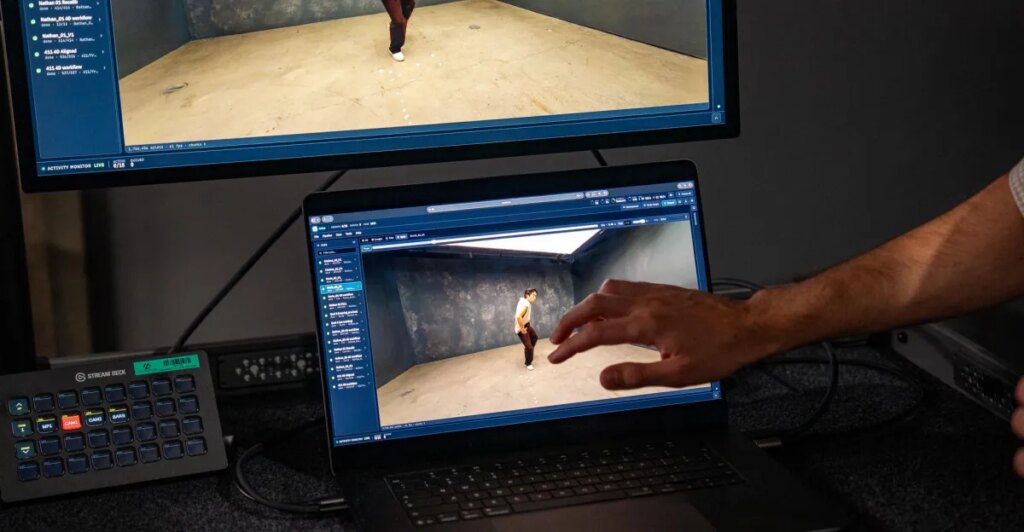
The new MacBook Pro brings with it a number of firsts for Apple laptops, the two most striking being an OLED display and touchscreen functionality. But as an image accuracy enthusiast, trained calibrator, and resident display expert, what excites me most about the MacBook Pro with PROLED XDR display is the technology it uses to display an accurate image. It’s the first laptop, and only the second product overall, to support Apple CMF 2026 color modes. It could be the future of displays.
CMFs, or color matching functions, mathematically represent how we perceive color and there are a few different variations. The specification that has been the standard for years is CIE 1931 (CIE stands for Commission Internationale de l’Éclairage, or International Commission on Illumination). For nearly a century, CIE 1931 has been a trusted calibration target, and most of the new MacBook’s reference modes use it.
But with the development of new display technologies over the past 20 years that have ultra-narrowband spectra (such as OLED, LEDs with KSF phosphors, and quantum dots), the shortcomings of CIE 1931 are becoming more apparent. Even when calibrated with the same D65 white point, the same image on an OLED and a quantum dot LED may appear identical to one person, but different to another due to biological variations in our eyes. We all have small discrepancies in our eyes, such as the sensitivity of the cones in our eyes, which allow us to see color, and these can change as we age. CIE 1931 does not handle this adequately and was created based on only 17 test subjects. Not ideal in a professional environment where content needs to look the same regardless of what screen technology it is on or who is viewing it. Apple CMF 2026 addresses that, so that displays look the same regardless of the technology they use.
Apple first included its new CMF in the Studio Display But the fact that this technology is now on a laptop and not just a standalone monitor that sits on a desk is a huge help for professionals on the go.
As with Studio Display XDR, the MacBook Pro with PROLED Maximum brightness with HDR and SDR content is 2000 nits (on the XDR monitor, SDR maximum luminance is up to 1000 nits) and the True Tone setting automatically adjusts HDR tone mapping, brightness and white point based on ambient lighting. (An option to turn off True Tone is in Displays preferences.)
The MacBook doesn’t require the use of Apple CMF 2026, as there are 14 more reference color modes that use the CIE 1931 color space (it’s still the standard, after all), including DICOM for medical imaging (which is great, but only useful for those in the medical field). MacBook also supports Apple Pro Display Calibrator, which includes three calibration methods to adjust reference color modes, or a custom mode, if necessary. There are options for a full calibration or to adjust a calibration with the appropriate measurement equipment, or to visually adjust the display.
Color science and display technologies have come a long way since 1931, when the CIE 1931 color space was established. Apple’s development of CMF 2026 and its standardization efforts (the company is currently working with a CIE technical committee on a proposed standard) is an important step in ensuring that current display technologies look the same to as many people as possible.
Expanding support to the new MacBook greatly expands the user base (let’s face it, more people are buying a touchscreen MacBook, even at $2,900, than a $3,300 professional monitor). More importantly, it gives professionals the ability to make the most of it in an easier and more portable way. access.