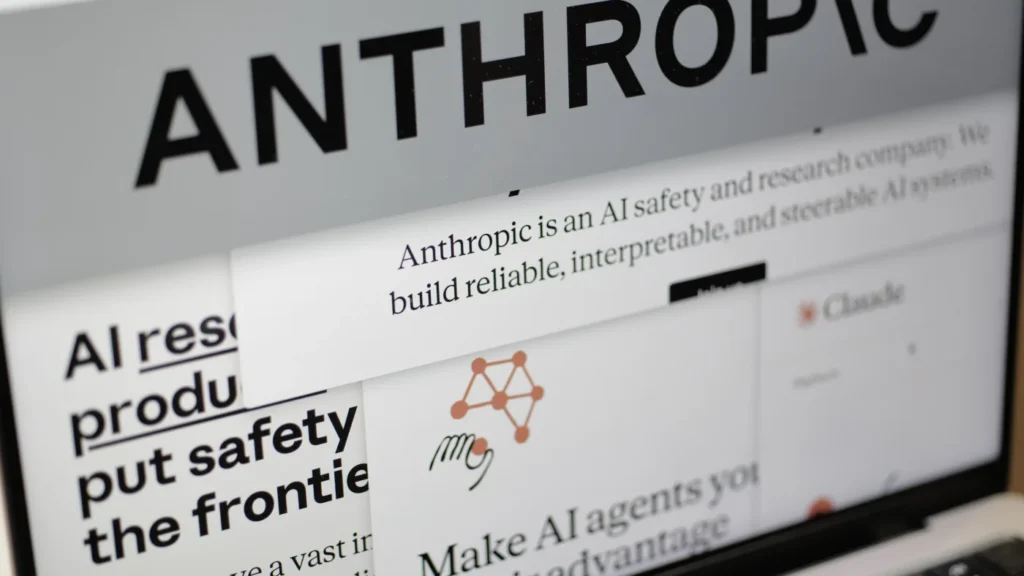
Anthropic is taking a big step toward a blockbuster stock listing that would rank among the largest IPOs in history.
Patrick Sison/AP Photo
hide title
Patrick Sison/AP Photo
Sign up to receive breaking news alerts and exclusive reports from NPR
Artificial intelligence startup Anthropic, maker of the wildly popular Claude AI models, has taken a major step toward completing an initial public offering that analysts expect to be one of the largest in history.
Anthropic on Monday filed final paperwork with regulators for an initial public offering (IPO) under the symbol ANT that could reportedly value the company between $1.5 trillion and $2 trillion.
That would put it on par with Elon Musk’s rocket and artificial intelligence company, SpaceX, which was valued at about $1.8 trillion when it went public in June. Anthropic’s listing prospectus did not say how many shares the company will offer or at what price range.
The filing of a public version of a registration statement called Form S-1 with the Securities and Exchange Commission is a major milestone in Anthropic’s meteoric rise. It was launched just five years ago by a dissident group of OpenAI researchers, led by Dario Amodei, who were concerned that that company, led by Sam Altman, was not on track to safely develop AI.
Since then, Anthropic has become a giant and OpenAI’s biggest competitor, with some of the most widely used AI models on the market. But the company has faced controversies, including a conflict with the Pentagon over how its models can be used and questions about Amodei’s dire warnings about the risks of AI.
AI Stocks Hit by Volatility
The filing comes at a volatile time in the stock market for AI-related companies, as investors swing between exuberance about the positive effects AI could have on the economy and concerns about security and the tsunami of investments in the technology.
The IPO, which could happen in November, will be one of the most anticipated public stock offerings in years. OpenAI, which makes ChatGPT, is also planning an IPO, but those plans are temporarily frozen, and Altman ruled out a listing this year as “ill-advised” amid growing concerns about AI safety.
“Going public has many advantages. It provides capital for growth. It makes it easier to raise additional capital elsewhere. And it makes it possible for existing investors to withdraw money,” said Jim Angel, associate professor and markets specialist at Georgetown University.
But, he added, “there is concern that we could be in an AI bubble. We are in a very dynamic industry, to say the least, and we can expect a lot of volatility in the markets.” Still, Angel said, it makes sense for Anthropic to “strike while the iron is hot” and list shares now to get as high a valuation as possible.
With SpaceX already publicly traded, Anthropic’s IPO could test investors’ appetite for AI companies at a time when markets are nervous about whether they can be profitable enough to justify the mind-boggling sums of money being poured into AI. SpaceX shares spiked briefly after listing, but fell back down to around $150, where they began trading.
Concerns persist over the AI sector
The balancing act for companies trying to ride the AI wave is real. Infrastructure and data center provider CoreWeave saw its share price fall this month as investors grew nervous about its ability to finance its expansion plans and its bond yields soared. Other major players, including Intel, Meta and Nvidia, have also been hit by concerns and have seen their share prices fall in recent weeks.
Debt financing has been a growing concern as AI-related companies rush to raise money to meet demand at a time when interest rates are poised to continue rising as the Federal Reserve attempts to quell persistent inflation.
The S-1 filing that kicked off the IPO outlined what Anthropic sees as risks to AI and its business model. Among them is the risk that its AI models develop faster than the company can keep them safe, or that they could be used to cause harm or take harmful actions on their own. He also noted the risk of increased scrutiny or political backlash over the company’s views on policies and regulations.
Amodei himself has issued some of the AI world’s sharpest warnings about the potential for AI to get out of control and cause harm, urging AI companies to “cross the line” or slow the development of their most capable models.
Anthropic has also clashed with the Pentagon this year over how the military can use its models. Amodei has drawn a line in the sand when it comes to using Anthropic’s AI for autonomous weapons and mass surveillance of Americans.
In response, the Pentagon blacklisted Anthropic and designated it as a “supply chain risk,” a label previously reserved for entities affiliated with U.S. adversaries. Anthropic has sued the Pentagon in two federal district courts. Those legal battles are still ongoing.