Folding done the Apple way
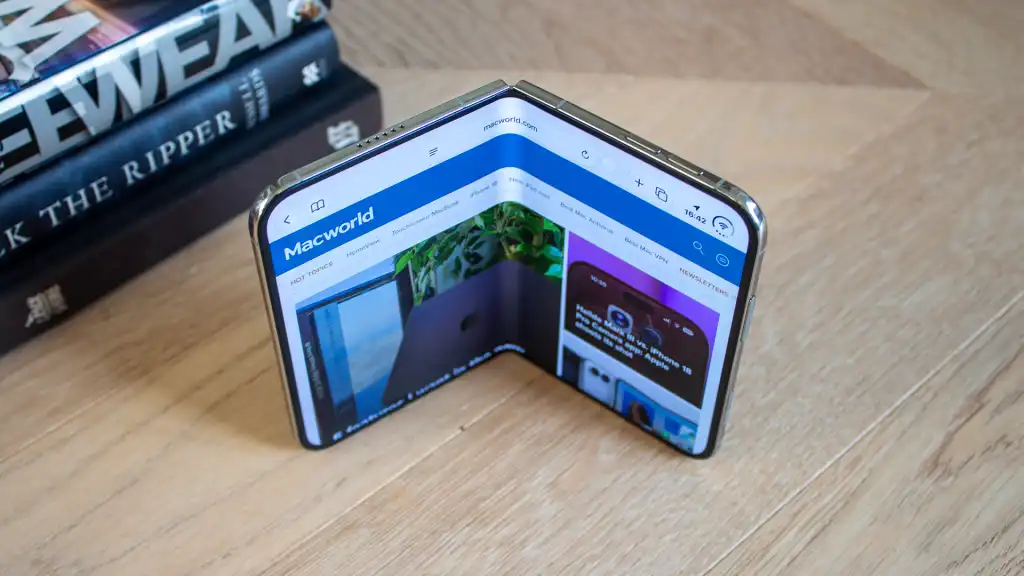
Like most first-generation Apple products, build quality is where the iPhone Duo shines the most. Its titanium frame feels more than durable enough for everyday use, and with an IP68 rating against dust and water, only the Google Pixel 11 Pro Fold matches its level of protection among foldables. The hinge is reassuringly rigid, so you can leave the Duo partially open at almost any angle, whether placed on a desk, propped up at a 90-degree angle, or somewhere in between, and it has a satisfying click when you close it.
Folded, the Duo takes up the size of a passport, making it compact enough to fit neatly in a pocket. It’s slightly shorter than the Galaxy Z Fold 8, and rather than follow Samsung’s symmetrical approach, Apple has given the Duo rounded corners on one edge and square corners on the other, similar to the Xiaomi 18 Fold. At first I wasn’t convinced by the design, but over the last week I’ve liked it more. I also found the curved side easier to hold when the phone is closed, and once unfolded, it looks like an iPad mini, making it clear why Apple chose the asymmetrical look. At 254g the Duo is heavy but I don’t find it too heavy and when open the weight feels surprisingly well balanced.
The iPhone Duo’s asymmetrical design is an acquired taste.
Britta O’Boyle/Casting
Face ID is the most notable omission, and anyone who’s used a newer iPhone in recent years will notice it. In its place is a Touch ID fingerprint reader built into the side button, an approach taken from the iPad, and it unlocks reliably whether it’s open or closed. However, after years of simply staring at my iPhone, even a quick task like resting a finger on the power button feels slow by comparison, and more than once I instinctively raised the Duo to my face and waited for it to unlock. Apple Watch owners can rely on their wrist to unlock the Duo, which softens the blow a bit, but it doesn’t help with passwords or Apple Pay purchases.
Apple also removed the Action button for the Duo and moved the volume keys to the top edge of the device, which I found (and still find) awkward. Neither the missing Action button nor the placement of the volume button is likely to be a deal breaker, but if you use the Action button like I do, it’s something to consider.
A matte screen that hides the crease.
The Duo’s two screens are excellent, with plenty of brightness, smooth scrolling, and plenty of power. The 5.4-inch outer screen is compact and comfortable to use with one hand, with dimensions that will remind long-time iPhone users of the nice 13 mini, albeit wider and thicker. Open the Duo and you’ll get a 7.6-inch interior panel with a glare-free matte finish, the feature I liked most when I first saw the Duo and which I still appreciate after a week of use.
Matte coatings aren’t new to Apple hardware, but this is the first time they’ve appeared on an iPhone and they make a big difference to the overall feel of the device. Glare is kept to a minimum and the crease is only noticeable when light reflects it or you run your finger over it, something that can’t be said for other foldable phones. The surface also feels smoother under your finger than the glossy screens on rival foldables. The trade-off is reduced contrast, so darker scenes lose some depth and spots are easier to spot. Unfortunately, the box also doesn’t include a cleaning cloth, which is standard when upgrading to the nano-texture finish on other devices.