Before there were cute little ones, there was Instinct.
In August, the startup launched its AI agent with an unusual playbook: invitation-only, no marketing, and barely a website. And yet, Instinct quickly became the most talked-about thing in AI, earning praise for its simple, text-based interface and its ability to handle tasks like booking DMV appointments and sending follow-up emails.
Then came Muse, followed shortly after by Dots. The same products, more or less, from two much more powerful companies.
With Big Tech players suddenly in the mix, it seemed doubtful that the startup’s successful launch could keep it ahead of the competition. But in my own testing, Instinct held its own against the other two agents, handling online tasks as well as a robot can. And Instinct founder Noah Shinn is unfazed by the growing competition.
“All we know are AI assistants,” Shinn tells me over email. While OpenAI and Meta create AI products for a variety of clients, Shinn believes Instinct’s approach sets it apart. “We’ve focused solely on creating a personal assistant for everyday life that just gets it.”
Shinn was an early employee at Sierra, another highly-rated startup with serious Silicon Valley pedigree, before striking out on his own to start Instinct. The quiet release quickly gained traction with praise from reviewers and a massive vote of confidence from investors. The company was valued at $10 billion at the end of September, even after the launch of Muse. There is no app or monthly subscription fee (for now). You will need an invitation from a current user or approval from a waitlist. I was approved after just a couple of hours.
Instinct’s AI assistant can do many of the same things that Muse did for me and, to some extent, OpenAI’s Dots. The kind of administrative life tasks, like signing up for swimming lessons and confirming appointments, that pile up with alarming frequency in a household of one preschooler and two adults with full-time jobs. These are more consumer-friendly versions of agents like Codex and OpenClaw that software developers have been using for the past year.
You chat with them as if it were a chatbot, but they also have access to a virtual machine and can connect to your personal email and calendar. And while Muse’s teddy bear mascot and Dots’ anthropomorphized spots seem like obvious attempts to capture a broader consumer audience, Instinct feels markedly different.
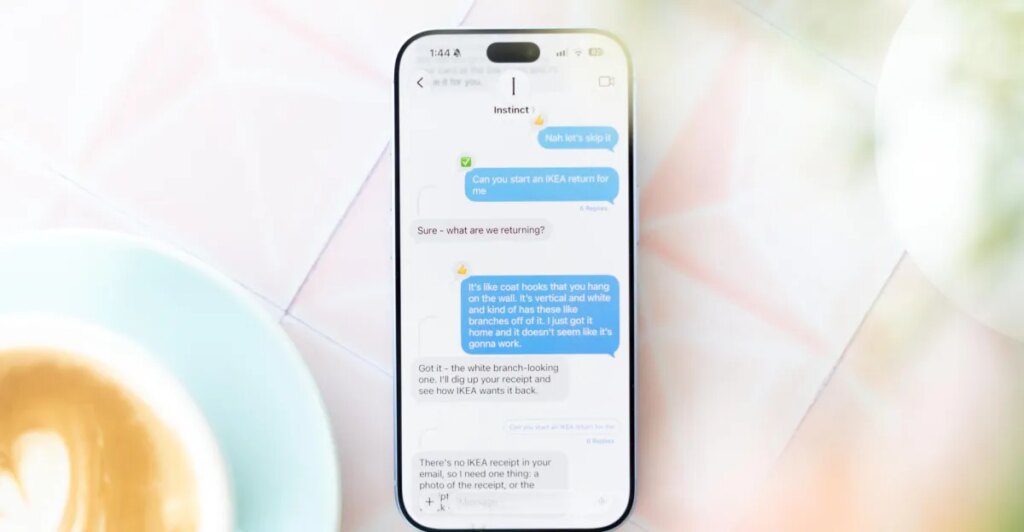
Conversations with the Instinct agent take place via text messages, either via iMessage, WhatsApp or email. There is no such thing as a cute little one. Without pretending that you are sitting in front of a laptop, typing on a keyboard. Just short answers, the occasional emoji reaction, and a lot more action than talk. It’s about as effective as I think we can reasonably expect an AI agent to be at this point, but the limitations of a robot in doing things in a human world are just as real.
The limitations of a robot in doing things in a human world are equally real
If you want Instinct to log into a particular website, you’ll get a link to enter details into a “secure vault” and can connect it to different services, including Google Workspace, Slack, and Notion. But otherwise, the interface is just your text messages. It’s a cool thing and means Instinct is anywhere you can send and receive text messages, like CarPlay or on your watch. It’s quietly nearby, which is either ideal or creepy, depending on how you feel about AI agents. I thought it was a little bit of both.
Shinn says the lack of a traditional app interface is a crucial part of what he believes separates Instinct from the big players. “While AI platforms excel at answering questions and prompts, Instinct integrates seamlessly into people’s lives to turn conversation into action,” he says. “Just like you would send a text message or email to your personal assistant, you can do the same with Instinct.”
At first the instinct did not impress me. After a couple of introductory messages, he took my Cincinnati area code as an invitation to send me a link to ResearcherThe website and a set of search results for flights between CVG and SFO. Thank you? I told him I don’t live in Cincinnati anymore. “Ha,” he said. “Noted: I’ll keep that in mind from now on.” But after giving it a steady diet of meaty tasks over the past few weeks, I’ve mostly been impressed, although I don’t think I’m any closer to reaching some kind of productivity nirvana.
1/2
I gave Instinct the somewhat vague task of finding swimming lessons for my son, something I’ve wanted to do for years but always seem to put off. I asked him to find age-appropriate lessons; He came back with a list of viable results. I suggested the neighborhood community center and they changed course to focus there. I opened a browser and followed it to check out its suggestions. All times and dates that came up were checked – a very low hurdle cleared. But he left out crucial information: The center has a prerequisite class for children who sign up for preschool-age lessons. I noticed this detail and it highlights a challenge that AI agents face: they are great with a clean set of data, but the internet was created by humans and the data often sucks. Sometimes, crucial information is hidden in a pop-up window.
Instinct handled a few other tasks well, like emailing my eye doctor’s office to schedule an appointment and doing the digital paperwork to initiate an Ikea return. Beyond simply filling out some forms for me, he was surprisingly good at handling vague instructions. I asked him to look through my previous Ikea purchases and he discovered what product I meant by “it’s vertical and white and has like branches.” (Tjusig, for those keeping score at home).
He sometimes surprised me by presenting relevant information that I had not explicitly requested. I began my request to email the ophthalmologist by acknowledging that I didn’t remember the exact name of the office. Instinct narrowed it down based on my description, and later in the conversation noted that I had a 2024 confirmation email from the doctor, just to make sure I was emailing it to the right place. On the other hand, Instinct also flagged a potential conflict on my calendar while it was doing another task for me. Filling out forms like a big, fancy autofill machine is one thing, and AI agents are quickly proving to be pretty good at it. But correctly identifying the relevant information and proactively bringing it to my attention seems like a real step towards reality. aid.
Correctly identifying relevant information and proactively bringing it to my attention feels like a real step towards reality. aid
Expect to pay for all of that in the future. When asked if Instinct would remain free, Shinn responded that “Instinct is free to invite-only users. Our intention is to keep it as affordable as possible.” Techsponential analyst Avi Greengart notes that the primary goal of a venture-backed startup like Instinct right now is growth. “The business model is to grow as quickly as possible to establish something worth paying for,” he says, noting that a company like Instinct could be looking for revenue from its customer base and/or an acquisition by a larger company.
OpenAI’s Dots are only available to paid subscribers at this time, while Meta’s Muse is free to use. “If you’re not paying for it, then the goods and services you’re looking for may be closing deals to get access to your agent,” Greengart theorizes. He acknowledges that the current economy is a bit shaky since agents are largely being used by early adopters right now, but he believes the old saying is true. “If it is not paid directly, it is paid indirectly,” he says.
That may mean more publicity in the future, according to Greg Ireland, senior director at IDC. “The fact that these agents are so dedicated to transactions, commerce or purchases makes it a natural choice,” he says. In fact, Instinct has already ventured into offering “recommended products” to its users. Companies have many incentives to make such advertising acceptable to consumers, but Ireland believes that ads will play a role in one way or another. “All roads in the consumer market ultimately lead to advertising,” he says. says.