CAPE CANAVERAL, Florida —
A private company launched another lunar lander on Wednesday, aiming to get close to the Moon’s south pole, this time with a drone that will jump into a black crater where the sun never shines.
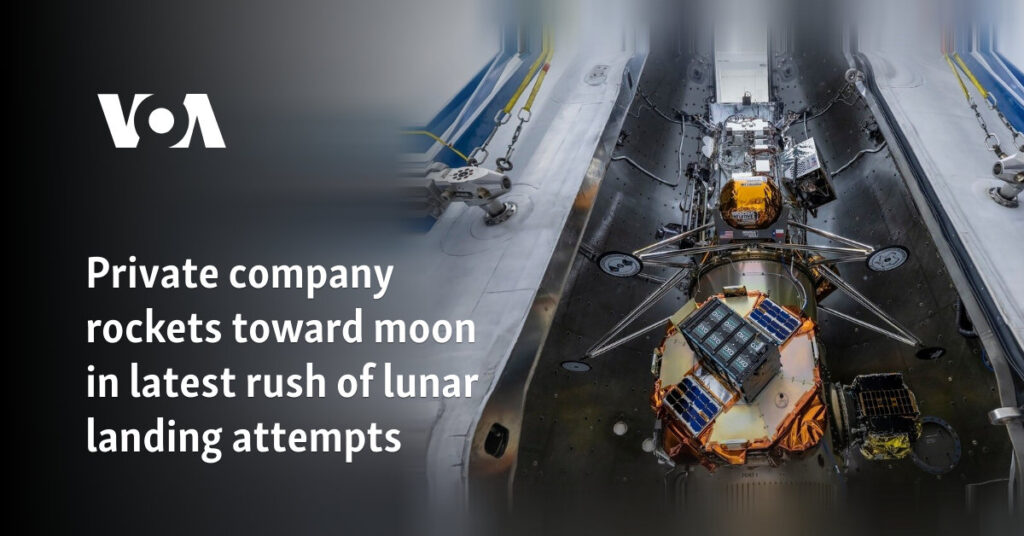
The Intuitive Machines lander, called Athena, lifted off with SpaceX from NASA’s Kennedy Space Center. It’s taking a fast track to the Moon, with a March 6 landing. The company hopes to avoid the fate of Athena’s predecessor, which capsized upon landing.
Never before have so many spacecraft headed toward the surface of the Moon at the same time. Last month, American and Japanese companies shared a rocket and separately launched landers toward the Moon. The lander from the American company Firefly Aerospace from Texas should arrive first this weekend.
The two American landers are carrying experiments worth tens of millions of dollars for NASA as it prepares to return astronauts to the moon.
“It’s an incredible moment. There’s so much energy,” NASA science mission chief Nicky Fox told The Associated Press a few hours before launch.
Last year, Texas-based Intuitive Machines made the first American landing on the Moon in more than 50 years. But an instrument that measures distance malfunctioned, and the lander fell too hard and broke its leg, tipping to its side.
Intuitive Machines said it had fixed that problem and many others. A side landing like last time would prevent a drone and a couple of rovers from moving. A NASA drill on board also needs a vertical landing so it can drill into the lunar surface and collect soil samples for analysis.
“Certainly, this time we will be better than last time. But you never know what could happen,” said Trent Martin, senior vice president of space systems.
It is an extraordinarily elite club. Only five countries have made a moon landing over the decades: Russia, the United States, China, India and Japan. The moon is full of remnants of many past failures.
The 15-foot (4.7-meter) Athena will aim for a landing 100 miles (160 kilometers) from the lunar south pole. Just 400 meters (a quarter of a mile) away is a permanently shadowed crater: the final destination of the drone named Grace.
The 3-foot (1-meter) drone, named after the late computer programming pioneer Grace Hopper, will make three increasingly higher and longer test jumps across the lunar surface using hydrazine-fueled thrusters for flight and cameras and lasers for navigation.
If those excursions go well, it will jump into the nearby black crater, about 20 meters (65 feet) deep. Scientific instruments from Hungary and Germany will take measurements at the bottom while searching for frozen water.
It will be the first up-close look inside one of the many shadowy craters that dot the north and south poles. Scientists suspect that these craters are filled with tons of ice. If so, future explorers could transform this ice into water to drink, air to breathe, and even rocket fuel.
NASA is paying $62 million to Intuitive Machines to take its drill and other experiments to the moon. The company, in turn, sold space on the lander to others. It also opened the Falcon rocket to ride-sharing.
The tagalongs included NASA’s Lunar Trailblazer satellite, which will fly separately to the moon over the next few months before entering lunar orbit to map the distribution of water beneath. Also traveling was a private spacecraft that will pursue an asteroid for a flyby, a precursor to asteroid mining.