Three weeks ago, Bambu Lab introduced the latest in home printing technology at $2,499; Now you can get many of its fancy new features for less than half the price.
Like the larger H3C, the new $1,149 Bambu P3C can also Swap materials on the fly, mix different colors to produce much of the rainbow, mix soft and hard materials, even mix different nozzle sizes and different filament diameters so you can switch between high speed and fine detail in a single print.
But Bambu took more shortcuts than I expected to hit the lower introductory price of $1,149 / £999 / €1,149 today, and I think they made more of a 3D printer for handymen than one suitable for beginners or professionals.
Some of the changes were completely expected, such as its smaller print area of 256 x 256 x 260 mm (very similar to Bambu’s other P-series printers) and that it supports seven auto-swapping tools instead of nine. (Seven is still quite (Particularly when affordable tool changers like the $849 Snapmaker U1 typically offer only four.)
But unlike the H3C, the P3C does not come fully charged and does not charge itself. while you have slot machine For seven rolls of filament and up to seven separate tools (including thicker-than-usual 2.85mm filament, or pens, cutting blades, and foil embossing and transfer tools if you want it to work like a Cricut), it only comes with five 0.4mm print nozzles by default.
And while five is still one color more than you’d get with an $800 Bambu P2S Combo, the 3D printer I’d buy for myself, the Bambu P3C Automated Materials System (AMS) is the first Bambu has shipped. without any motor to automatically load its filament.
Don’t get me wrong: you can still keep five colors of filament ready to use at any time, one more than the P2S, by keeping them loaded into the P3C’s five independent nozzles. You can also purchase and install two more print heads quite easily, although they cost up to $100 each.
But loading those nozzles is a slow and surprisingly manual process that involves pushing a strand of filament down a tube, a fairly long distance by hand, after waiting for the machine to preheat each one, and it feels like a step back after years using previous motorized versions of Bambu’s AMS. On the other hand, P3C doesn’t have to spend time and purge filaments between colors like P2S does.
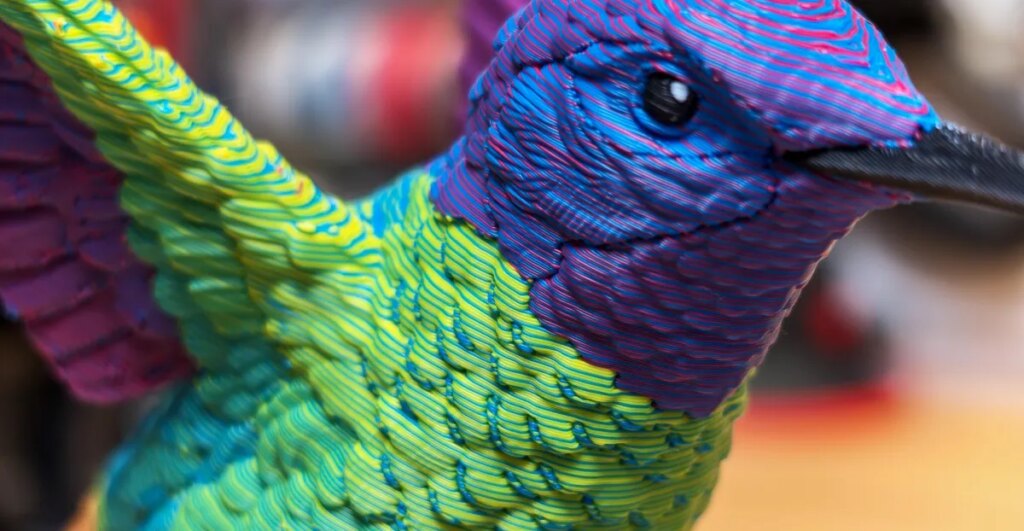
I expect many 3D printing enthusiasts will see $1,149 for the Bambu P3C as a good deal, assuming they haven’t written off the company’s devices after the Bambu open source bug. Even five nozzles are enough to load Bambu’s five rolls of cyan, magenta, yellow, black, and white (CMYKW) “PLA Palette” filaments to blend colors and produce beautiful creations like the company’s new hummingbird test print, which turned out nearly perfect on my first try.
But you should know that mixing colors isn’t necessarily a foolproof way to produce some colors, like the brown tree branch that’s supposed to be the hummingbird’s perch, and I’m not really looking forward to manually pulling and pushing a roll of brown filament to change that. Bambu says you should probably try a feature called “mixed color sublayer” for better results, and I also suppose you could daisy-chain a regular motorized AMS to one of the P3C’s print heads, since that’s a supported workflow. But that’s why I suggest we’re in bungler territory.
I asked Bambu about the decision not to include filament loading motors in the P3C’s AMS system, and here’s part of the statement I received from spokesperson Karlie Hou: “The AMS 3P’s design deliberately omits the auto-loading feature as part of the effort to deliver premium multi-head performance at about half the price of the flagship H3C system, allowing a much broader audience (hobbyists, small studios, and educational institutions) to enjoy a premium multi-head printing experience. multicolored”.
The company claims that manually refilling five nozzles should take about five minutes. “In the next [software] update, our goal is to reduce the total handling time for loading five reels to less than a minute,” the company writes, although it seems like a tall order.
Maybe I’ll put the P3C through a year-long test like I did the P2S, and see how often I need something that CMYKW can’t do for me and if the filament stays dry when left in the print heads for a long time. The question is: Which printers should I test with? Are there any upcoming ones I should wait for?