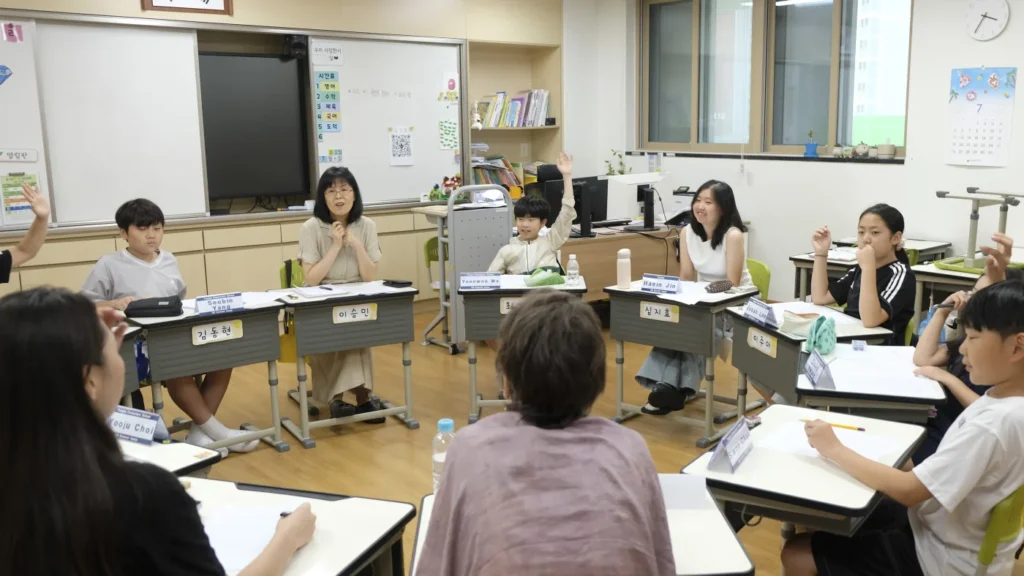
Student Ma Yeonwoo, center, raises his hand during a Great Books summer camp seminar on Mary Shelley’s novel Frankenstein at Toegye Elementary School in Chuncheon City. Teacher Han Kyoung-min, to Ma’s right, leads the discussion.
Anthony Kuhn/NPR
hide title
Anthony Kuhn/NPR
CHUNCHEON, South Korea — “Is Frankenstein’s Monster Human?” a teacher asks students at Toegye public elementary school in the city of Chuncheon, about 50 miles east of Seoul, as they discuss Mary Shelley’s novel. frankenstein.
“I think we can call him a soulless human being,” ventures student Ma Yeonwoo.
Toegye School has adopted the “Educational model “Great Books” used by St. John’s College, whose main campus is in Annapolis, Maryland.
The class discussion then turns to whether artificial intelligence is human.
“No,” Ma Yeonwoo replies, because humans created AI, and although it is intelligent, “it has no creativity.”
In the “Great Books” model, professors do not lecture, they only guide discussions. There are no majors or elective courses. Students do not look for answers in external sources such as the Internet and rely solely on their readings, their own reasoning, and class discussions with their peers.
That suits Ma Yeonwoo, who says he likes to debate with his classmates.
“If only the teacher talks we can have one idea, but if we all debate together, we can get many ideas together,” he says.
This nascent educational movement addresses several worrying trends. One is that international tests such as PISA have shown a post-COVID decline in South Korean reading skills, after decades in which South Korean and other East Asian students outperformed their American counterparts.
Another is South Korea’s rapid adoption of AI in education. 51% of South Korean students say they use artificial intelligence chatbots to study at least once a week, according to figures from the Organization for Economic Cooperation and Development (OECD). Students also face intense competition to pass college entrance exams, increasing pressure on them until preschool level and leading many South Korean families to send their children to cram schools to gain a competitive advantage, or to foreign schools to escape the system.
Professor Lee Yonghwa (center) of Incheon National University leads a Great Books Summer Camp seminar at Chuncheon High School. Lee, a graduate of St. John’s College, established South Korea’s first Great Books program at his university in 2019.
Anthony Kuhn/NPR
hide title
Anthony Kuhn/NPR
“We all feel that this system leaves students with no time to read and think,” because they are too busy memorizing facts to pass exams,” says Lee Yonghwa, a professor of English language and literature at Incheon National University, where he co-founded South Korea’s first “Great Books” program in 2019.
But now, Lee laments, “Korean students are losing even their former ability to memorize facts because they gather data and ideas primarily from AI.”
And if they can’t reason and think independently, he adds, they can’t judge the quality of the results that AI generates for them.
The limitations of their education system motivate many South Koreans to seek alternatives, from education abroad to educational experiments at home.
“As someone who went through this system, I felt those limitations deeply,” Chuncheon Mayor Yook Dong-han said in an interview at City Hall. “When I became mayor, I wanted to introduce a different type of education and a different educational philosophy to Chuncheon City.”
Chuncheon draws visitors from neighboring Seoul to enjoy its mountains, lakes and rivers, and dakgalbi, a local dish of marinated grilled or stir-fried chicken.
Chuncheon government set up academic center association with St. John’s College last year to promote the “Great Books” educational model.
According to Lee Yonghwa, there are currently 120 university students and about 770 younger students participating in the “Great Books” program in South Korea, and 40 teachers in training.
Although the program is still in its infancy, Yook says it represents a “small but revolutionary achievement, a breakthrough that challenges established practices” and generated interest among participating students that exceeded their expectations.
South Korean students who follow the “great books” model read Aristotle, Shakespeare, Euclid and Korean authors, including the Nobel Prize winner. Han Kang.
Student Shin Donghyun reads Martin Luther King, Jr.’s book Letter from a Birmingham Jail at a Great Books summer camp seminar at Chuncheon High School.
Anthony Kuhn/NPR
hide title
Anthony Kuhn/NPR
At a Chuncheon high school, students read Martin Luther King Jr.’s 1963. Letter from Birmingham Jail.
They discuss King’s ideas about what kinds of laws are just and unjust, and what laws citizens should obey or disobey.
Lee Yonghwa says he is impressed that students connected King’s letter to their own country, such as in 2024, when citizens and lawmakers defeated former President Yoon Suk Yeol’s attempt to place South Korea under martial law.
This fits the purpose of the “Great Books” model, in which “each seminar table really becomes a miniature republic, where ideas clash but people cooperate,” St. John’s College President J. Walter Sterling wrote last year in a opinion essay.
Through civic engagement and liberal education, he adds, “we quietly sew the fabric of our democracy…before it falls apart beyond repair.”
NPR’s Se Eun Gong contributed to this report in Chuncheon and Seoul.