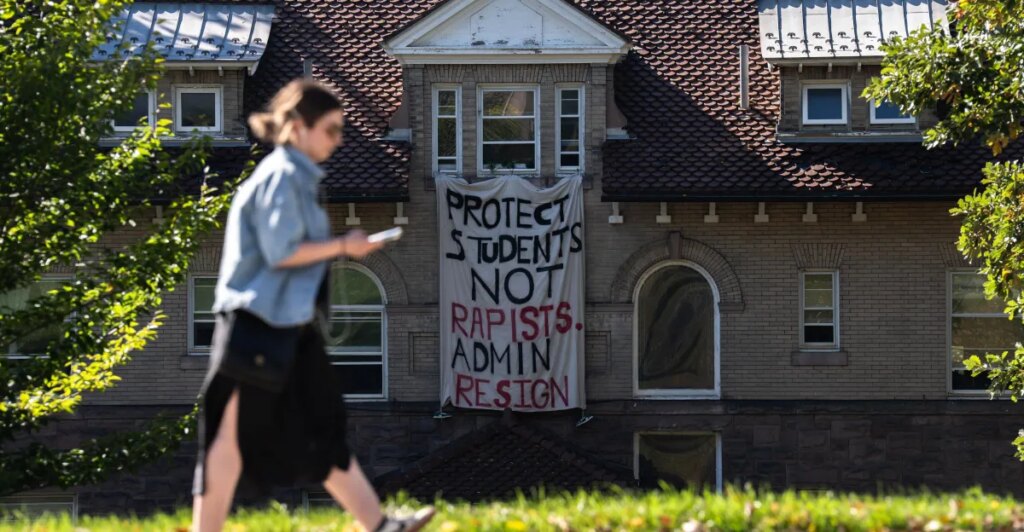
Who is Jane Doe? Online vigilantes have sought to expose the Cornell University student who filed a lawsuit accusing seven members of a fraternity of gang rape, and in doing so have sparked a torrent of abuse against several other women. Her attorneys say three women have been falsely identified and harassed, and the real Jane Doe is also being inundated with threats. “She is not well,” her lawyer Thomas Guiffra told CNN on Sunday. “She is under siege on social media, where people are trying to identify her.”
The fact that several women are now facing a torrent of online abuse in connection with the Jane Doe lawsuit is not surprising. Targeted harassment and intimidation campaigns were a hallmark of the #MeToo backlash. These targeted harassment campaigns were once organized on websites such as Kiwi Farms and 4chan. But the effort to unmask Jane Doe (and terrorize any woman they believe is Jane Doe) is being carried out openly, on major social media platforms that are doing nothing to stop it.
Jane Doe’s identity is not a total secret: it is known to her lawyers, the judge presiding over the case, the seven men she accuses of rape, and also her lawyers. In civil cases, the anonymity of the plaintiff is ultimately up to the judge, who weighs several factors, including whether identifying the plaintiff by name will put him or her at risk of physical or mental injury. “In New York, there is no automatic right to proceed anonymously,” said Annie Seifullah, founding partner of victims’ rights firm Incendii Law. Still, “the law recognizes that survivors’ lives are routinely put on trial, and that forcing them to file a lawsuit under their real names would prevent many victims of sexual violence from coming forward.” Similarly, journalistic ethics guidelines often suggest showing sensitivity toward victims of alleged sexual crimes, and journalists often allow people who report abuse to do so anonymously, as long as their identity can be independently corroborated.
The attempt to expose Jane Doe began at Tracey said she considered her identity fair game “as her lawsuit did not hesitate to name and shame 7 of her peers as gang rapists.” Aidan Thompson, founder of the AF Post – a publication dedicated to articulating “the ideas, beliefs and values of the America First Movement” – also asked for help identifying Jane Doe. “Beev, please help me discover the Cornell girl,” he posted on September 29, referring to the “burnerverse,” a network of anonymous X accounts whose members discuss college sports and pay-harassment campaigns against women with equal enthusiasm.
“The fact that people try so hard to deceive and harass her and other people, women who they just think could be her, it underscores how serious her concern for privacy really is,” said Katie McKay, senior associate at CA Goldberg, a victims’ rights firm that specializes in technology-facilitated abuse. “Obviously anonymity is necessary. “It is protecting her, to some extent, from even more harassment, even more attacks and retaliation.”
X’s terms of service expressly prohibit users from sharing a person’s private information without their consent and threatening to do so; The site has also banned people who post alleged pseudonymous usernames. But the names and photos of non-users are not considered “private information,” even if they can be used to unearth current private details such as your telephone number or home address. X’s rules also say that users “may not attack others with abuse or harassment, or encourage others to do so,” but the platform is inundated with posts disparaging women believed to be Jane Doe. X did not respond to a request for comment.
In X, Thompson posted photographs and biographical details of a woman he claimed was Jane Doe. Tracey later identified the same woman as Jane Doe on her Substack, claiming to have seen her name in court records. In fact, Tracey got the name from court records. aggregator — a website that disinformation researcher Jared Holt says was registered in mid-September and appears to selectively post information about polarizing cases, such as Clavicular and Lindsay Clancy.
Despite Tracey’s repeated claims that Jane Doe’s identity was a matter of public interest, many comments on her Substack post focused on the sexual attractiveness of the alleged Jane Doe and how this relates to the veracity of her allegations. On Anonymous accounts have circulated their Instagram and TikTok posts and created AI deepfakes of the woman named by Tracey and Thompson.
Substack is also known for its lax content moderation policies. The platform took a laissez-faire approach to publishing and, in 2023, refused to remove or demonetize several Nazi posts from its website. Tracey has apparently benefited from her Jane Doe posts: Substack lists her newsletter at No. 66 in its political rankings. Substack did not immediately respond to a request for comment.
Most survivors do not report and this is why.
Tracey, for her part, deleted the post in which she claimed to have identified Jane Doe, not because of her poor sourcing, but because she claimed to have made her point clear: High-profile litigants should not be allowed to be anonymous, especially when they accuse others of rape. “That is all I ever sought to achieve here,” he wrote. “This is not to impugn this young woman on a personal level. I have no hard feelings toward her, and never have. I sincerely wish her the best and hope her life is not defined by this calamity.” Tracey did not respond to a request for comment.
Jane Doe is not anonymous to the court. “Underlying this is the belief that it is somehow unfair to these defendants that she is anonymous and they are not. But they know who she is,” McKay said. “I see no lack of responsibility, even as a Jane Doe, in voluntarily submitting her claims to the scrutiny of a court, with the subpoena power and the court’s power of discovery.” Because the defendants know Jane Doe’s identity, their attorneys will be able to request access to her medical records, psychiatric records, and personal communications. “If the concern is that she will not be held liable for any type of false accusation, the entire process is designed to examine these allegations and only allow the claim to move forward (and for her to potentially recover something) if it is deemed meritorious upon examination of all of this evidence.”
And regardless of the stated motivations for doing so, anyone who has spent any time on X since 2022 (or on the Internet in general) would know that identifying a woman as Jane Doe would inevitably result in that woman suffering a torrent of abuse. Either Thompson and Tracey identified and directed harassment toward an alleged rape victim, or they directed harassment toward an unrelated woman in their quest to expose the identity of an alleged rape victim. These harassment campaigns impact beyond their intended goals, creating a broader culture of bullying. “I’ve already had many clients call me asking if they should worry about being misled by their Jane Doe status,” said Seifullah, the victims’ rights attorney. “Most survivors don’t report and this is why.”
Ironically, Tracey now complains that an online mob is not only after her family but is also targeting the new owners of her childhood home, with which she has no relationship.
Harassment of people coming forward with sexual assault allegations is not a new phenomenon, but McKay noted that rigorous efforts were made to protect the identity of Emily Doe, a woman who accused Stanford swimmer Brock Turner of rape in 2015, and “I don’t remember much of a doxxing campaign,” McKay said, even after Emily Doe’s victim impact statement went viral. When Chanel Miller came forward four years later, the news of her identity was truly revealing even to those who had criticized her during the high-profile Turner trial.
“I think interest in ‘exposing’ victims is going to increase these days,” McKay said. Although it’s impossible to pinpoint what changed, McKay pointed to harassment campaigns targeting Amber Heard and E. Jean Carroll, two women who publicly accused famous men of rape. “Those women were publicly identified and were torn apart and brutally attacked by the public,” McKay said. “I don’t know if maybe that has created more interest or expectation that in each case non-litigant observers will be allowed to separate the victim, but it seems pretty clear to me that that’s what they want to do here.”
Just as the #MeToo movement encouraged women to share their stories, the attempt to expose Jane Doe has generated a new wave of solidarity. On TikTok and Instagram, hundreds of women responded to Tracey’s request for information about Cornell’s alleged victim with an “I am Spartacus” campaign proclaiming to be Jane Doe. Some women are even coming forward with their own stories of sexual assault.
Sarah Lupica, a 24-year-old content creator with more than 1.5 million followers on TikTok, posted a video about how she was sexually assaulted when she was 16 years old. “For a long time I blamed myself for being in that situation,” Lupica told me. Until now, he said, he lacked the language to explain what happened to him. Lupica was 13 at the height of #MeToo and had no memory of the movement. It didn’t reach him. The moment passed, the culture changed, and the abuse of women persisted in a culture that is even more hostile toward survivors.
For Lupica, #IAmJaneDoe is a way to not only share her own story but also show other women that they are not alone. Lupica said she was encouraged by the number of other women who reached out. “I was very moved by that and the whole movement of saying ‘I’m Jane Doe,’” she told me. “It means that you are with her and with everyone who has been afraid to speak out: the survivors who never got justice and the girls who are really trying to understand what happened to them.”