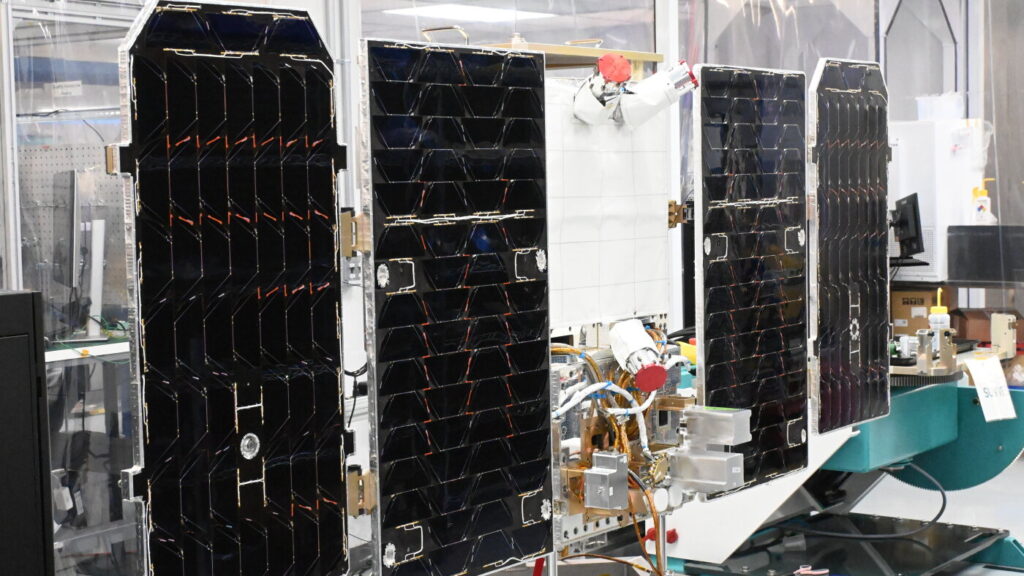
A prototype of the Project Suncatcher satellite at the Planet Labs facility in San Francisco, California.
Planet PBC Laboratories
hide title
Planet PBC Laboratories
Google just sent a satellite the size of a refrigerator into space, as part of a research project that the company hopes can pave the way for orbiting artificial intelligence data centers powered by the sun.
The satellite prototype has four special chips called Tensor Processing Units, or TPUs, which Google designed for machine learning and has already deployed in data centers on Earth. The chips will run a version of the company’s Gemma AI model for 15 minutes at a time due to heat management limitations, using the open weight model to answer simple queries. in a blog postGoogle said the mission will evaluate how TPUs handle “the physical stresses of spaceflight and the radiation and thermal extremes of space.”
The use of AI has increased considerably in recent years, driving demand for data centers. At Google’s annual developer summit in May, CEO Sundar Pichai saying Demand for AI services outstrips supply and it expects capital expenditures this year to be between $180 billion and $190 billion (more than six times higher than in 2022) as the company builds computing infrastructure and develops chips.
At a time when opposition to the proliferation of energy-hungry data centers on Earth is growingGoogle is one of a handful of companies advancing plans to put them into orbit where there is virtually unlimited free energy and no protesters.
“The sun produces almost all of the energy in our solar system. All other energy sources that humanity has harnessed are only a small fraction of a percent,” said Travis Beals, senior director and leader of the Suncatcher Project. “So in a sense, this project is about harnessing the best way to use solar energy to run AI computing.”
The satellite will be in a sun-synchronous orbit where its solar panels will almost never be in the shade. That eliminates the need to carry heavy batteries or backup power on the spacecraft.
Last November, a venture capital-backed startup called Starcloud launched. a spaceship which carried an Nvidia H100 chip on board and demonstrated a version of Google’s Gemini AI from space. Elon Musk’s SpaceX is also working on space data centers and has saying expects to begin deploying “orbital AI computing satellites” from 2028.
Google developed the experimental satellite in collaboration with the aerospace and satellite imaging company Planet. He eventually envisions groups of satellites orbiting together to form space data centers. Each satellite will carry dozens of TPU chips and communicate with each other (and Earth) using lasers. Next year, the company plans to launch two more satellites into orbit to test their connection.
The satellite launched today is a prototype that Beals called “a minimal test” to make sure the chips can work in space. A SpaceX rocket launched it into orbit and Planet will put it into operation. Beal said Google will get going and test TPUs. The goal is for the mission to be operational for one year.
The satellite prototype was tested in a thermal vacuum chamber that simulates the environment in space.
hide title
Brandon Lucia, a professor of electrical and computer engineering at Carnegie Mellon University, said the idea sounds “very science fiction,” but much of the technology has been tested at the research level.
Still, there are enormous challenges. The heat is great. Computer chips heat up, and on Earth the heat can be dissipated by wind or water. That is not possible in the vacuum of space.
“On a particular satellite, using more energy to do the calculations means throwing more heat into the confined environment inside the satellite,” Lucía said.
In its blog post, Google called Cooling the chips is “a crucial research challenge” and he described some of the approaches he is working on, including using a combination of pipes and radiators to move heat away from the chips.
Beal said the radiators are one of the heaviest components of the current mission (a drawback because it is more expensive to launch heavier objects) and his team is working on ways to cool the chips more efficiently.
Lucía points out that there are also important questions about maintenance. When a chip fails in a terrestrial data center, or something breaks, a technician can come in and fix it. That’s more difficult when the data center rotates hundreds of kilometers above the Earth.
“They all have their cost and complexity amplified by a factor of 10, maybe a factor of 100. So there has to be a big payoff,” Lucia said.
And there are also environmental issues. While space data centers would be powered by solar energy, the rockets that launch them run on carbon-based fuels. And over time they will re-enter Earth’s atmosphere, potentially adding pollution as they burn up.
Elon Musk has said that space is the “only way to scale” data centers to meet future AI demand. But the economy remains a question mark. Launches are expensive, repairs difficult, and laser communication over hundreds of miles and through Earth’s atmosphere is slower. And constellations of many satellites will be needed to match the computing capacity of a terrestrial data center.
Beals said he and his small team think a lot about these questions. “It doesn’t help much if this is technically possible, if it’s always going to be too expensive to be practical,” he said.
He added that it is difficult to know when space data centers will be economically viable. “I don’t see it being cheaper to do it in the next five years. I think it will take longer,” he said.
And he doesn’t think space data centers will replace terrestrial data centers anytime soon. “I think there will be use cases that make more sense on Earth and use cases that make more sense in space,” Beals said. “In the long run, maybe the set of things you do in space gets bigger and bigger until that’s where most of the computing happens. But I think for a long time the two will coexist.”
The entire project, he said, is a “moonshot.”
“It’s going to take a long time,” he said. “It won’t be a completely smooth journey.”
Google is a financial sponsor of NPR.