WASHINGTON-
Chip giant Taiwan Semiconductor Manufacturing Co. on Monday announced plans to make an additional $100 billion investment in the United States and build five additional chip factories in the coming years.
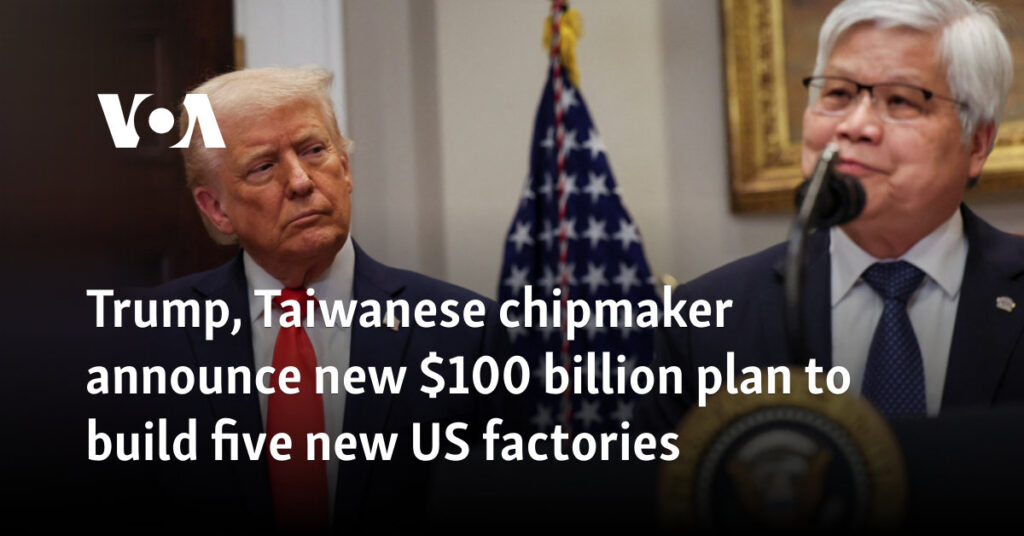
TSMC CEO CC Wei announced the plan in a White House meeting with President Donald Trump.
“We must be able to build the chips and semiconductors we need right here,” Trump said. “For us it is a matter of national security.”
TSMC, the world’s largest contract chipmaker, is a leading supplier to major U.S. hardware manufacturers.
The $100 billion outlay, which would boost domestic production and make the United States less dependent on semiconductors made in Asia, follows a major previous investment announcement. TSMC agreed in April to expand its planned investment in the United States from $25 billion to $65 billion and add a third factory in Arizona by 2030.
With his Nov. 5 election victory driven largely by voters’ economic concerns, Trump has stepped up efforts to boost investments in domestic industries to create jobs.
TSMC’s announcement is the latest in a series of such developments. In February, Apple said it would invest $500 billion over the next four years. Emirati billionaire Hussain Sajwani and SoftBank have also pledged multibillion-dollar investments in the US.
TSMC said Monday that it looks forward to “discussing our shared vision for innovation and growth in the semiconductor industry, as well as exploring ways to advance the technology sector together with our customers.”
The US Commerce Department, under then-President Joe Biden, ended a $6.6 billion government subsidy in November for TSMC’s US unit for semiconductor production in Phoenix, Arizona.
Biden signed the CHIPS legislation and the Science Act in 2022 to provide $52.7 billion in subsidies for semiconductor production and research in the United States.
Taiwan’s dominant position as a maker of chips used in technology from mobile phones and cars to fighter jets has raised concerns about over-reliance on the island, especially as China ramps up pressure to assert its sovereignty claims.
China claims Taiwan as its territory, but Taipei’s democratically elected government rejects Beijing’s sovereignty claims.
Under the Biden administration, the Commerce Department convinced the five cutting-edge semiconductor companies to locate factories in the United States as part of the program to address national security risks from imported chips.
Trump’s Commerce Secretary Howard Lutnick told lawmakers last month that the program was “a great down payment” on rebuilding the sector, but he declined to commit to any grants that have already been approved by the department, saying he wanted to “read them, analyze them and understand them.”
A TSMC spokesperson said last month that the company had received $1.5 billion in CHIPS Act money before the new administration came in under the historic terms of its deal.
Last year, TSMC agreed to produce the world’s most advanced 2-nanometer technology at its second Arizona factory that is expected to begin production in 2028. TSMC also agreed to use its most advanced chip manufacturing technology called “A16” in Arizona.
TSMC has already started producing advanced 4-nanometer chips for US customers in Arizona.
TSMC’s award included up to $5 billion in low-cost government loans.