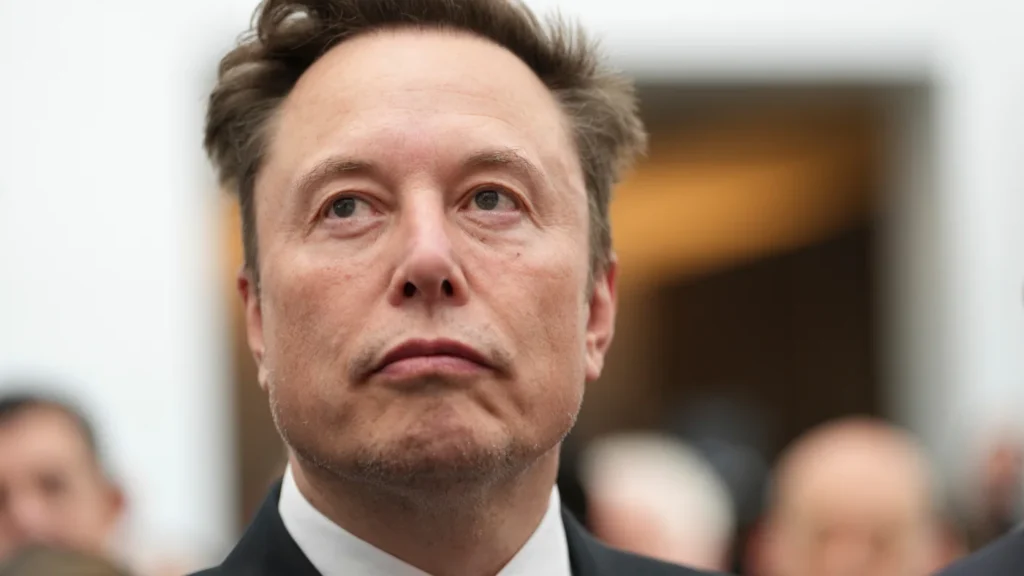
FILE – Elon Musk listens as President Donald Trump speaks during an event at the U.S. Institute of Peace, Oct. 8, 2026, in Washington.
Julia Demaree Nikhinson/AP
hide title
Julia Demaree Nikhinson/AP
The Trump administration on Wednesday gave SpaceX the green light to deploy 1 million satellites that it said would create data centers in space, a lofty goal for Elon Musk’s rocket company, in a move that has sparked skepticism and alarm among some scientists.
The US Federal Communications Commission hailed its authorization as a historic first amid the race for artificial intelligence. He said SpaceX’s one million “orbital computing modules” (forming a constellation of data centers called “Starmind”) would process massive amounts of data to be used on Earth and bring humans closer to harnessing “the full power of the sun.”
“The United States is ushering the world into the age of super intelligence,” FCC Chairman Brendan Carr, who was appointed by Republican President Donald Trump, said in a statement. He added that Wednesday’s move “opens a bold new frontier.”
A more extensive authorization order released by the FCC said the company must deploy at least “one authorized space station” by 2033, and then gradually add more and more through 2040. Musk welcomed the decision on social media.
The world’s richest man has long promised to form vast solar-powered data centers in space to help run artificial intelligence tools on Earth. But scientists and industry experts have highlighted enormous technical and financial hurdles, as well as a host of environmental concerns.
Adam Becker, astrophysicist and author, called the prospect of launching a million satellites into space to create data centers “a fantasy.”
“That’s not going to happen,” he said Wednesday.
Proponents of data centers in space argue that capturing the sun’s energy would relieve pressure on power grids and reduce demand for sprawling computing warehouses on Earth (and resources like water needed to cool them). Space seems to offer a solution because it is cold, but it is also a vacuum that traps heat inside objects much like a thermos. Becker explained that there are “basic physical limits” to radiating that heat, and sending many smaller satellites could carry the necessary material combined, but it would be expensive and difficult.
He and others also point to additional risks, such as air pollution through launches and re-entries, as well as possible collisions in orbit that could affect other essential satellites.
“You could end up with a series of cascading collisions of space junk,” Becker said, noting that such crashes could create “a cloud of debris” in low-Earth orbit, where many weather and telecommunications satellites are also located.
In its ruling, the FCC held that SpaceX’s proposed Starmind constellation operates in a manner consistent with its rules on orbital debris. It also acknowledged that it had received a “substantial amount” of public comments prior to its authorization on Wednesday, including requests to deny SpaceX’s application. But the regulator maintained that satellite deployment “serves the public interest” and said it was ruling out issues over which it had no authority, such as environmental concerns.
The American Astronomical Society, satellite communications company Viasat and Amazon-owned Kuiper Systems were among those calling on the regulator to reject SpaceX’s proposed data centers in space.
In a statement Wednesday, the AAS said it was “disheartened and dismayed” by the FCC’s decision. The organization said SpaceX’s proposed positioning of data centers in low Earth orbit would undermine decades of federal investment in astronomical facilities and “the ability of astronomers and the public to enjoy and study the night sky.”
“The proposed constellation involves larger (and therefore brighter) and more numerous objects,” AAS said, noting that “these satellites would therefore be visible as extremely bright objects for longer periods in the night sky.”
Becker echoed that sentiment. “It is also pollution of the night sky with the naked eye,” he said.
Viasat, Amazon, SpaceX and the FCC did not immediately respond to The Associated Press’ requests for further comment Wednesday.