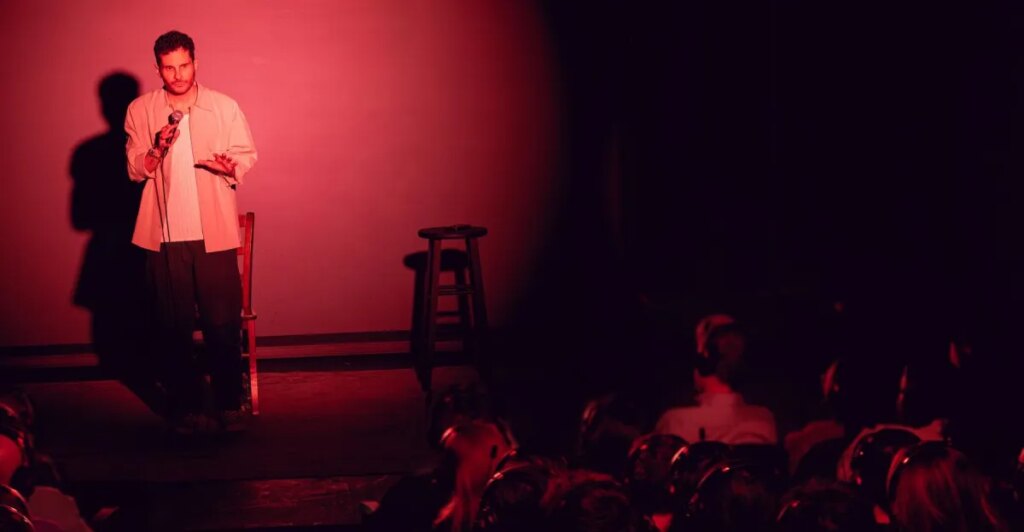
I climb some concrete steps and walk through the front door of a 200-year-old townhouse in New York City, following a crowd of people to the 178-seat SoHo Playhouse. As we filter to our seats, ushers hand each person a black drawstring bag with a pair of wired headphones connected to a small Auracast receiver. Then, shortly after the play begins, we are instructed to put them on.
Headphones are an integral storytelling tool. love me — a one-man show from the mind of the comedian and former Saturday night live writer Drew Michael and director Prashanth Venkataramanujam. It is a show about love and the search for connection, told in five chapters about different relationships in Michael’s life, united by the threads of his hearing loss and his self-discovery.
love meThe experimental sound design is made possible by Auracast, a Bluetooth-based technology that can transmit a high-quality audio stream to any number of nearby devices. As the show follows Michael from childhood to adulthood, sound designer Daniel Kluger uses headphones in combination with the theater’s speakers to create experiences that wouldn’t be possible with a traditional setup. Tinnitus and hearing test tones are played in the music between sections as subtle clues as the show builds toward Michael’s epiphany about his hearing loss. Kluger also explores the world through different levels of sonic clarity. The sound played through the theater’s speakers is sometimes intentionally muffled, but then the headphones muffle it even more, giving the audience an idea of what Michael is hearing at those moments.
But one sound that remains clear and pristine is Michael’s inner monologue, which plays over headphones throughout the show. The inner monologue consists of pre-recorded tracks and the live feed from Michael’s microphone on stage as he talks to himself. “Every time you’re in my head, anything in the headphones comes through clearly,” Michael tells me after the show. “[We’re] also trying to highlight that the attractiveness of the inner world is such that it is the space of greatest fidelity for this person. “It’s more comfortable.”
Different sound sources and sound treatments can lead to scenes that are intentionally confusing for the audience. During one, where Michael is doing a monologue at a comedy club, three sounds compete for attention: the theater’s speakers play the crowd’s reactions (including an interlocutor whose voice is sometimes muffled and sometimes clear); his pre-recorded inner monologue reacting to the crowd plays over headphones; and on stage, Michael is performing the set, with his microphone muffled so that our attention is focused on his inner monologue. It is one of the definitive moments where the audience feels the constant concentration necessary to analyze what happens when the sounds are unclear and become overwhelming.
But the biggest impact comes during a climactic scene that the sound design has been building toward, a realization that also incorporates footage from a series of Michael’s audiograms over the years. “I had a breakthrough in the whole story of what I had been doing: the cognitive work, the work invisible to me that was affecting every minute of my life,” Michael says. “That was a great moment.”
That’s when the audience is instructed to remove the headphones we’ve been wearing for almost the entire show. As Michael comes to terms with his relationship with his hearing loss and the mental clarity it brings him, the thing we’ve grown accustomed to throughout the entire show experience (the headphones) is gone, as is that literal weight of our heads. It’s an emotional moment, one I’ve thought about several times since watching the show.
It also leads to the final act, where Michael begins to understand his own deaf identity. “Deafness is not to blame, it is the denial of it.” he tells me. “Currently my hearing has never been worse, but I have never felt more self-affirmed or self-actualized nor have I felt happier with myself. I think it is a mistake to consider deafness as a tragedy, deafness as a deficit, deafness as a burden, deafness as something that torments a person.”
Auracast’s ability to stream an audio stream to which any number of headphones can be connected is what made love me a possibility. Any Auracast headset can connect to the audience stream (I brought the Nothing Pro 1 to test the capability and connected to the audience stream channel in seconds), but I used the Auri receiver and Austrian Audio headphones provided for the presentation. The sound of the program was designed with that in mind, and I didn’t want the different isolation of the Nothing headphones to affect the intent of the experience.
love me is presented in partnership with Deaf West Theatre, which supports deaf-centered storytelling in theater productions. In addition to the Auracast audience feed, there is one for hearing aid and cochlear implant users that is designed to comply with those devices, and iPads with captions are also available. During the performance, Michael connects to his own streaming channel with Auracast-compatible Phonak Eon Sphere headphones. “We talked about using in-ear monitors, but if I use an in-ear monitor, then I don’t have amplification of my surroundings, so I lose contact with the audience,” says Michael. “These work as two things: they’re headphones and they’re also in-ear monitors.”
love me relies on Auracast technology to tell its story, but it’s not a story about hearing technology. Technology is there to tell the story of connection and discovery of identity. “I think right now… there are two things that are at odds: the hearing aid and audiology technology side of deafness and then the cultural identity side of deafness,” Michael says. Technological improvements, such as cochlear implants and hearing aids, are cited as one of the reasons why deaf schools have been in decline, leading to children being mainstreamed (placed in regular public schools) and losing deaf history and culture. “I’m not against technology,” Michael says, “I just think technology and deaf identity should be a marriage rather than a division.”
And that collaboration is the reason love me It works as well as it does. The Auracast technology is there both for accessibility (in the same way it is already used in other presentations, lectures or announcement systems) and to enhance the show’s story of love, acceptance and recognition of one’s deaf identity. It is an inventive use of technology that carries a powerful message.