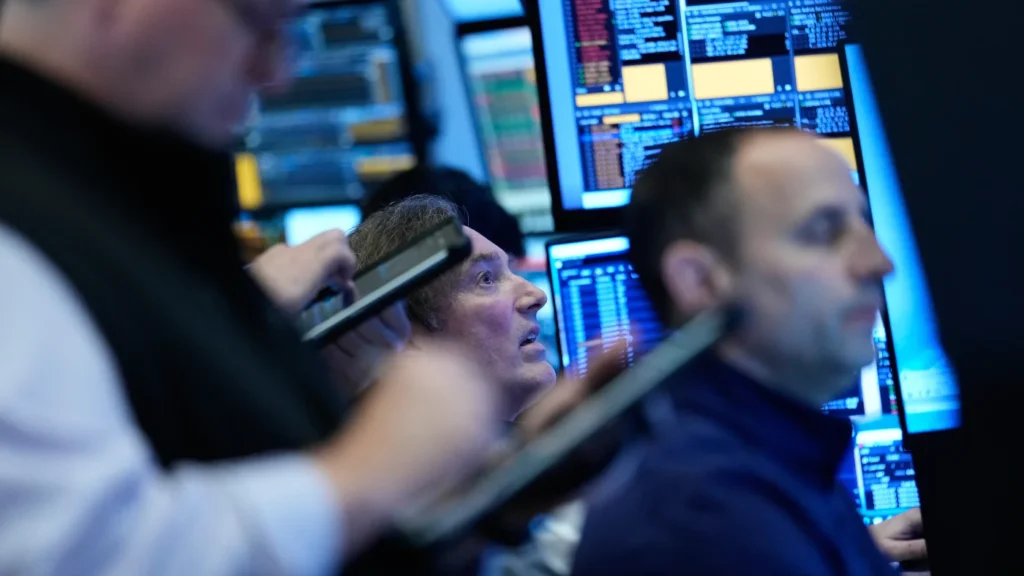
Traders work at the New York Stock Exchange in New York, Tuesday, Nov. 17, 2026.
Seth Wenig/AP
hide title
Seth Wenig/AP
NEW YORK – A sharp sell-off in AI stocks on Friday sent the S&P 500 down 3.7%, dragging the index to its worst weekly loss in more than 18 months and pushing the Nasdaq composite into the red for the year.
The benchmark index is now in what professional investors call a “correction”, having fallen more than 10% from its all-time high on October 6.
The last time the S&P 500 had a correction was in March 2025, when the Trump administration’s trade war shook the market. Its weekly loss, marking its worst drop since April 2025 as the trade war escalated, capped a seven-day losing streak, the longest since the start of the COVID-19 pandemic in 2020.
The Nasdaq composite, which is most influenced by technology stocks, fell 5.3%, taking it into negative territory for the year. Its weekly loss was also just shy of its worst week since March 2020, when the pandemic crippled the global economy.
The Dow Jones Industrial Average, with less exposure to technology stocks, fell 1.9%.
Chip stocks such as Nvidia, Micron Technology, Broadcom and Advanced Micro Devices were hit hardest by the selling, but other companies linked to AI development also tumbled, including optical products company Corning and energy supplier Bloom Energy. Artificial intelligence laboratory Anthropic, which successfully went public on Thursday, fell 9.1%.
The sell-off in tech stocks spread across the globe, with Japan’s Nikkei and South Korea’s Kospi each falling more than 5% overnight. European indices also fell sharply.
AI stocks have high market values and have a much greater impact on the direction of the market. They were responsible for Wall Street’s big gains this year and now they are behind the market’s big crash.
AI trading has been losing steam in part over concerns that AI stock’s large market values and heavy spending are unjustified. Fears of a bubble within the sector have also been exacerbated by the results of the recent midterm elections, in which candidates advocating a slowdown in data center construction won at both the federal and state levels.
“I think the whole notion that AI can continue to spend unlimited amounts of money and support the stock market is ending as we speak, that’s what’s being priced in right now,” said Michael Antonelli, market strategist at Baird. “But I don’t think that means the overall bull market that started in October 2022 is over.”
Much of the AI decline focused on chip stocks, which have been big beneficiaries of the buildout of AI data centers. Advanced Micro Devices sank 13.3%, Micron Technology fell 13.9% and Broadcom fell 12.1%. The PHLX semiconductor index sank 10.7%.
Corning fell 10.9% and Bloom Energy lost 15.3%.
Nvidia, considered by many to be the poster child for the rise of AI, fell for the ninth day in the last 10, closing down 13.8%. The chip company’s shares became caught up in market anxiety over the strength of AI development and, more recently, came under pressure from concerns about its future following the sudden fall of Jensen Huang, its former CEO and co-founder. Since the Huang scandal broke earlier this month, the stock has fallen more than 25%.
The big market debut of Anthropic, maker of the Claude AI tool, flopped on Friday with the rest of the tech sector. The stock fell 9.1% to $88.30, but remains above its IPO price of $83 per share. It was the largest public stock offering in history, at one point surpassing $2 trillion in value.
Anthropic’s share price drop on Friday amounts to a roughly 23% drop from its brief peak of $115.10 per share set the day before. This is an even bigger drop than the drop seen by Facebook (now Meta) in the early days after its May 2012 IPO.
The market debuts of technology companies are usually followed by a volatile period. SpaceX, which previously held the title of largest IPO, rose nearly 50% in its first three days, but fell below its IPO price a month later.
However, outside the technology sector, most stocks were gaining ground. Cheerios maker General Mills rose 3.7% and homebuilder Lennar gained 1%.
In total, the S&P 500 fell 265.44 points to 6,910.39. The Dow Jones fell 949.73 points to 48,147.33 and the Nasdaq lost 1,261.47 points to close at 22,617.73.
While stock market sentiment has soured, sentiment among American consumers appears to have improved, a reversal of dynamics seen earlier this year.
The latest consumer confidence index from the University of Michigan rose sharply compared to last month, slightly above economists’ expectations. Consumers noted some relief from easing gas prices and improved expectations about business conditions after the midterm elections. Still, sentiment remains below the level of February, before the start of the US war with Iran.
Treasury yields fell in the bond market. The 10-year Treasury yield fell to 4.93% from 5.04% late Thursday.
Brent crude oil, the international standard, rose 0.6% to settle at $92.57 a barrel, amid continuing tension near the Strait of Hormuz as the US war with Iran continues. Saudi Arabia said on Friday that Iran-backed Houthi rebels had fired more missiles and drones at the kingdom days after it launched a major air campaign in Houthi-controlled parts of Yemen. Iraq apparently reached a compromise with a powerful Iranian-backed militia that it accused of oil smuggling.